Is Penthesilea in the Iliad?
Penthesilea was the Amazon Queen who came to Troy to face Achilles. Homer mentions her exactly once — a single line in the Iliad's catalogue of Troy's allies. Then she disappears from the poem, the way someone points at something interesting at a party and walks off without explaining it. She never appears as an active figure in the Iliad itself.
Her full story lived somewhere else, in a poem called the Aethiopis. Arctinus of Miletus composed it in the eighth or seventh century BC, picking up where Homer's Iliad leaves off. That poem is now lost. We know its contents only through summaries written centuries later — the ancient equivalent of a plot synopsis scrawled in someone's margin.
This is the normal condition of ancient literature. Most of it is gone. What survives does so largely by accident, the way one jar survives a kitchen fire because somebody left it on the wrong shelf.
A Daughter of Ares, a Sister in Blood
What survives tells us this. Penthesilea was the daughter of Ares, god of war, and of Otrera, a mortal woman who founded the Amazon nation. Otrera also built the first temple to Artemis at Ephesus — a fitting founding achievement, the ancient world apparently felt, for a nation of warrior women. That parentage made her half divine and half human. In Greek mythology, that split usually produces the most interesting and the most catastrophic stories: the gods giving with one hand, mortality taking with the other.
Her sister was Hippolyta, the Amazon queen whose girdle Heracles stole in his ninth labour — the kind of family connection that makes dinner conversation complicated. Hippolyta was already dead by the time Penthesilea came to Troy. And here the myth turns genuinely interesting, not just exotic: Penthesilea killed her.
Not deliberately. That's the standard mythological caveat, the accident that complicates the moral rather than absolving it. She threw a spear on a hunt and missed her mark, the kind of error with no obvious villain and no obvious remedy. In the Greek moral framework, killing a sibling left a wound that did not close on its own. Penthesilea came to Troy partly because Priam had offered her the purification rites she needed. And partly, one suspects, because fighting someone else's war beats sitting still with what you have done.
The ancient Greeks imagined the Amazons as a nation of warrior women somewhere to the east, living without permanent men. Daughters stayed; sons went back to their fathers, or — in the darker versions — were left on hillsides. It was always a more useful idea to Greek mythology than an honest ethnography.
The Amazons exist in myth to be defeated: by Heracles, by Theseus, by Achilles. They lose with impressive regularity. The myth required it, and delivered, and the consistency is itself the point. A society the Greek world kept needing to defeat, over and over, tells you exactly how threatening it found women with weapons and no king.
Penthesilea arrived at Troy with twelve companions. All of them are named in Quintus of Smyrna's Posthomerica, the poem written in the third or fourth century AD that gives us our fullest account of her story. In places it reads like a man trying very hard to fill gaps left by a poem he admired but could not read.
What Achilles Felt When He Saw Her Face
Quintus gives us the battle in full. Penthesilea fights brilliantly. She kills Greek heroes, drives the army back, fights the way the Greek poetic tradition reserves for people it has decided to dignify with a good death.
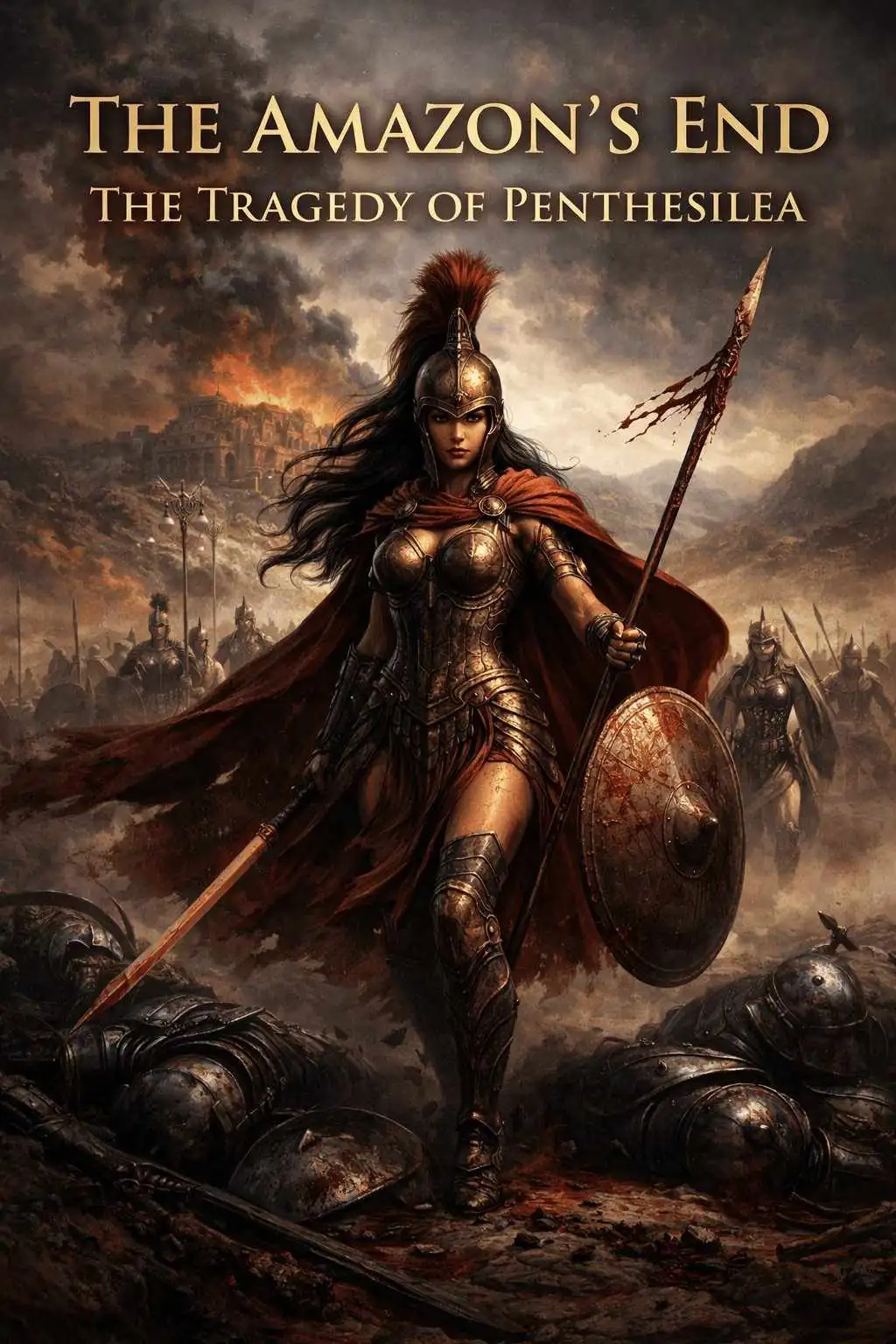 The war seen from the losing side, and the women written out of it. That’s my novel The Amazon's End. Read it on Amazon →
Then Achilles arrives, as Achilles always arrives, and the outcome is never in doubt. He kills her.
What happens next is the reason the ancient world kept returning to this image. He removes her helmet. He sees her face. And something happens to him that the ancient sources circle around without quite naming — the way you circle a word in a foreign language that has no translation in your own.
Grief is one word for it. Love is another — and the word the ancient sources reach for more often, with all the discomfort that implies. Love for a woman he has just killed is either the definition of tragedy, or a very particular kind of recognition that arrives exactly too late (the Greeks invented both tragedy and stage recognition as a device; they understood this better than most).
Then comes the detail most retellings leave out. Thersites mocked him for it. He was the ugly, loud, democratically-minded soldier who is the Iliad's most recognizably modern figure, and in the version the myth preserves, he said something about the absurdity of mourning an enemy.
Achilles killed him for it. That created its own political problem: Thersites was a cousin to Diomedes, and killing a Greek over grief for a dead Trojan ally was the kind of thing that required an explanation.
Writing The Amazon's End, I found what interested me most wasn't the battle. It was the moment of recognition — the irony the myth buries in a single scene. Achilles, the greatest warrior alive, meets someone he might have considered a peer at the exact moment that consideration stops mattering.
The ancient world kept painting this scene on pottery. Dozens of examples survive. They kept returning to it the way you return to a question with no satisfying answer — not because the answer is hidden, but because the question is the point.
Myth survives in fragments: summaries of lost poems, captions on pottery, and — if a figure mattered to enough people across enough centuries — a novel written two and a half thousand years later. Penthesilea was interesting enough. She always was.
Homer knew it. He gave her one line and moved on, trusting his audience to fill in everything he left out. They could, once. Most of what they knew died with them — and one line is all that is left to prove she was ever more than that.
The Amazon's End: The Tragedy of Penthesilea
The full account of Penthesilea's story — from Themiscyra to the Scaean Gate, told in the voice that has carried the Myths of the Ancient World series from the beginning. Drawing on Arctinus of Miletus and Quintus of Smyrna, with opinions about what both of them chose to leave out.
Also on the blog: