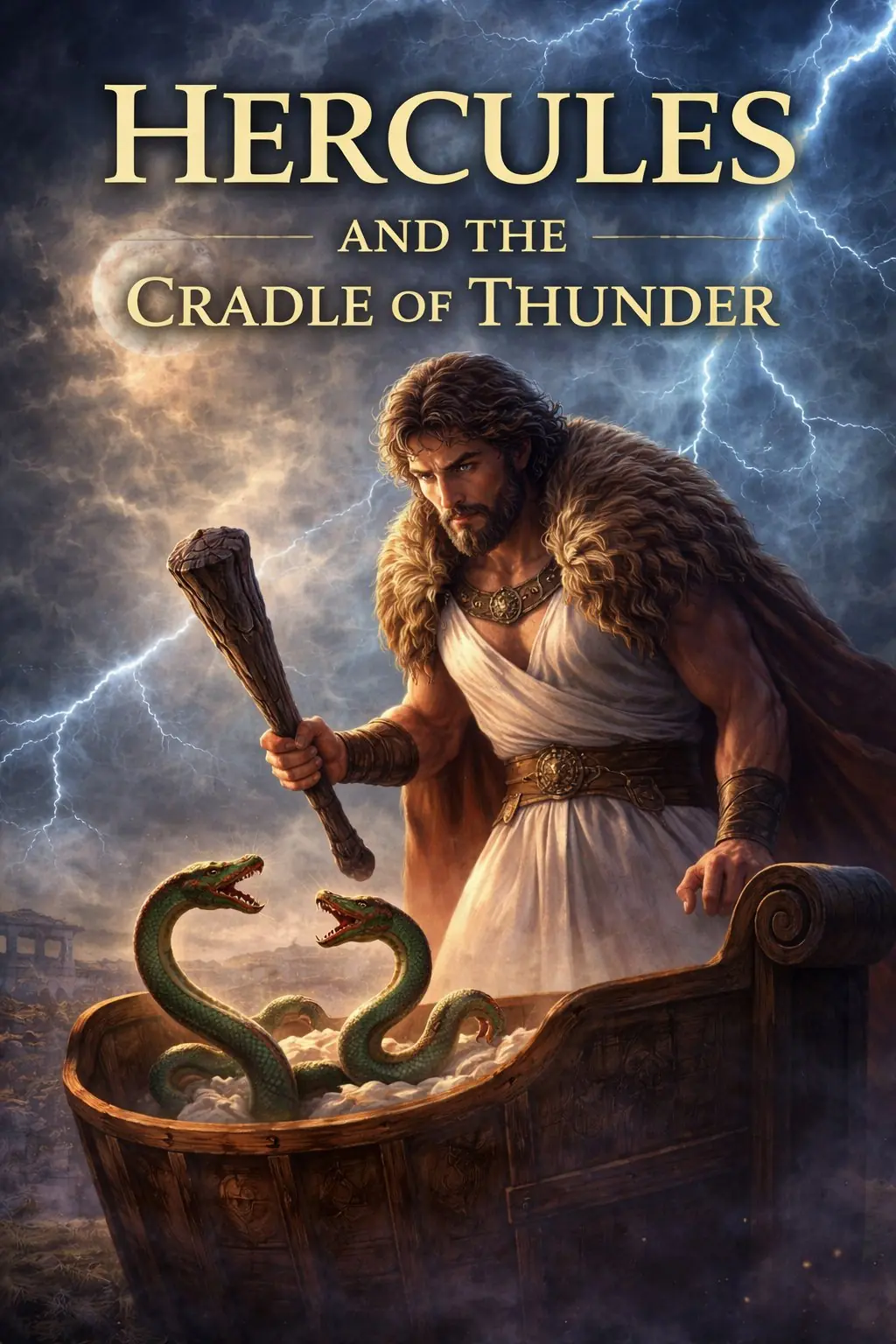
Hercules and the Cradle of Thunder
Hercules and his twelve labours are famous — but not for the reasons this novel explores. What is less well known is what it costs a man to be remade, task by task, into something a god can use — and what happens to everything else while the remaking is taking place. The myth of Heracles rewards a second reading precisely because the legend has omitted so much.
Heracles was not a simple man. He was large, certainly, and violent when violence was called for, and the legends do not minimize this. But he was also capable of grief so profound it became a kind of madness, and of loyalty that outlasted the people who first earned it. The labours did not begin as penance for something abstract. They began as the result of what that grief and madness produced on a specific night in Thebes, in a specific house, with consequences that the oracle at Delphi could not undo — only redirect.
Hercules and the Cradle of Thunder follows the greatest hero of the ancient world from Thebes to the pyre on Mount Oeta — in a voice that has very little interest in celebrating the legend at the expense of the man inside it. Heracles was warm, the narrator observes early on, the way a forge is warm: intensely, purposefully, and with the understanding that the warmth existed to shape things.
Drawing on Apollodorus's Library, Diodorus Siculus, and the tragic tradition from Euripides, the novel follows the full arc of Heracles's story — the infancy, the labours, the marriages, the deaths, and the pyre — in the voice that carries the series from beginning to end.
"He was warm the way a forge is warm: intensely, purposefully, and with the understanding that the warmth existed to shape things."