There is a question worth asking about the Trojan War: who actually ran Troy? Not militarily — that was Hector, the eldest son, a competent and serious man who understood that wars are mostly logistics dressed up in occasional acts of courage. But behind Hector stood Priam, sentimental and impulsive, the kind of king who made decisions the way you make a purchase you regret before you even get it home. Behind Priam stood fifty princes, several hundred household servants, and the shifting population of a palace under a ten-year siege. Someone had to keep the water running, the grain counted, and the chain of command intact — someone had to keep the city from collapsing on itself before the Greeks ever burned it from without. The ancient sources are not especially forthcoming on who that someone was. They are, however, consistent in their portrait of Hecuba. Read that portrait carefully, and the answer becomes obvious.
Hecuba was the daughter of Dymas, king of Phrygia — or Cisseus, king of Thrace, depending which ancient source you trust. That disagreement tells you something: the tradition cared more about Hecuba as a symbol than as a woman with a fixed set of parents. She married Priam when he was already a king, young enough that the match counted, in the language of the time, as entirely appropriate. She gave him children — nineteen by Priam himself, according to the Iliad, plus a number of others from earlier unions the sources treat with varying degrees of discretion. Hector was the eldest, the great one, the son the poets celebrated for centuries. Paris was the beautiful one, and he caused the war — which Hecuba had always known he would. Before his birth, she had dreamed she gave birth to a torch that burned Troy to the ground. A seer told her what the dream meant. She sent the baby to die on Mount Ida.
He did not die. This was perhaps inevitable, given his family.
Ten Years of Losing
The war lasted ten years — a long time by any measure, and an extraordinarily long time to watch your sons die one after another, with the relentless regularity of a creditor working through a list. Hector fell in the tenth year, killed by Achilles. His body was dragged behind a chariot for twelve days, then ransomed back — an episode the Iliad treats as one of its great moral climaxes, old King Priam sneaking into Achilles's tent to beg for his son's corpse. Hecuba is there in that scene, and she tries to talk Priam out of going. She knows, with the precision of a woman who has spent a decade calculating odds, that Achilles is as likely to kill him as not. Priam goes anyway. This is, in miniature, the whole dynamic of their marriage.
After the fall, the Greeks divided the Trojan women by lot among their commanders — the way you might divide up an unusually good shipment of goods. Hecuba's lot fell to Odysseus: short, wiry, famously clever. His vanity was the intellectual kind, the sort that can't be managed with a compliment about how you look. The pairing is deliberately cruel on the myth's part — the most controlled woman in Troy, handed to the most intellectually self-regarding of the Greeks, with all the power reversed and no way back.
And then, on the shore of Thrace, on the way to Greece, she found the body of her youngest son.
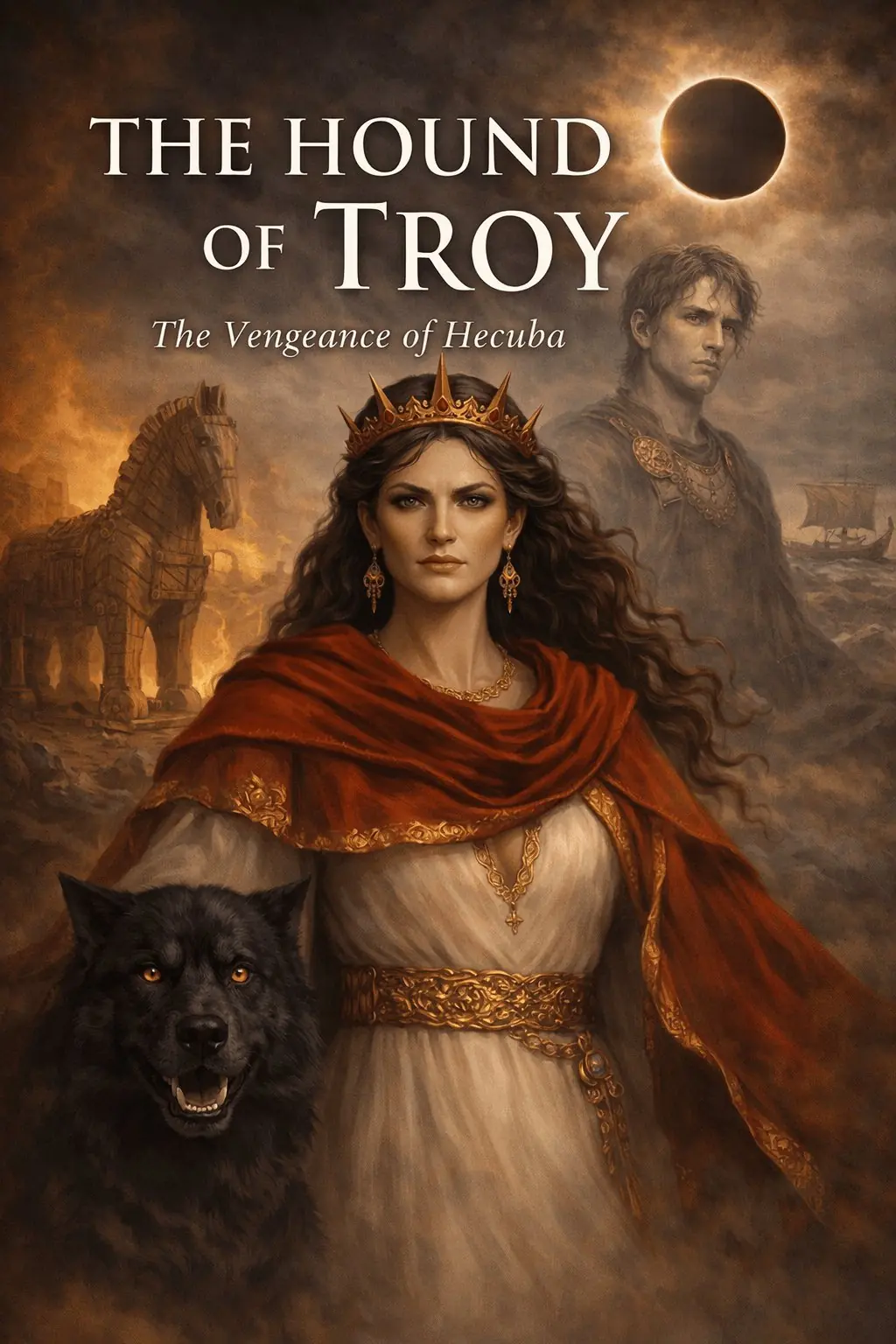 Troy's fall from inside the walls, and the people the epics rush past. That’s my novel The Hound of Troy. Read it on Amazon →
Polydorus and the Blue Tunic
Polydorus was the youngest of Hecuba and Priam's sons. Two years before the fall, he was sent to the court of Polymestor, king of Thrace, who had married Hecuba's daughter Ilione and was, in the language of the arrangement, a trusted ally. Priam sent the boy with a substantial amount of gold — either prudent provision for the family's future, or catastrophically naive optimism about what men do when handed a fortune with no one watching. When Troy fell, the gold stopped being an accompanying detail and became the whole point of the arrangement. Polymestor killed Polydorus and threw his body into the sea.
Hecuba found it washed ashore. She recognized it because the boy was wearing his blue tunic. He was fourteen years old.
What happened next is the center of Euripides's play Hecuba, written around 424 BC. Among other things, it is an extended argument about what grief does to a person's sense of justice — and whether the two can even coexist once grief passes a certain magnitude. Hecuba requested an audience with Polymestor, ostensibly to discuss hidden treasure. She brought her women. Inside the tent, they blinded Polymestor with the pins of their brooches and killed his sons. The Greeks, who had been packing to sail home, were forced to hold a trial instead. Agamemnon — who had reasons of his own for not being entirely hostile to Hecuba — ruled in her favor. Then, according to the myth, she was transformed into a black dog on the headland of Cynossema, the Dog's Tomb, and her howling carried out across the water for as long as the water ran.
This is why Euripides wrote two plays about her — Hecuba and The Trojan Women — rather than one. She is the figure through whom the whole human cost of the war runs: every son, every daughter, every city, every certainty, stripped away one by one. The sequence ends not in death but in something the myth frames as punishment. Read closely, it looks more like release. The dog is not a diminishment. It has nothing left to lose, nothing left to suppress, no composure left to maintain. It howls because it can.
Writing The Hound of Troy, what I found most interesting about Hecuba was not her vengeance, spectacular as it is. It was the decades before it — the iron control, the habit of filing away everything unbearable into a place inside herself where it could not interfere with the work of running a palace and keeping fifty people alive in a city under siege. The vengeance is the moment the archive breaks open. Everything she ever folded up and put away in the dark comes out at once — and it comes out through the eyes of a Thracian king. The myth calls this transformation. It might just as easily be called honesty. After fifty years of composure, the black dog with fiery eyes was simply what had been there all along.
The Hound of Troy: The Vengeance of Hecuba
Book Three of the Myths of the Ancient World series. Hecuba's complete story — from supreme queen to the Thracian headland — told in the voice that has carried the series from the beginning. Drawing on Euripides, Homer, and Ovid, with opinions about what all of them got wrong.
Also on the blog: