Eurystheus set ten tasks at first, not twelve. Two were struck once Hercules had already finished them. The Hydra didn't count because his nephew Iolaus helped sear the wounds shut, and the Augean stables didn't count because Hercules asked to be paid for a day of shoveling. Two replacements went onto the list to bring the number back to a tidy dozen (a king quietly fixing his own arithmetic). What survives is twelve labours built on two disqualifications nobody talks about.
What the labours are not is a checklist of monsters. Read in order, they are twelve proofs of a single problem the myth has been circling since the cradle: a man too strong for the world he was born into, sent to do that world's impossible jobs by a cousin who was afraid of him. The famous fights are here, but so is a year spent chasing a deer that could not be harmed, and an afternoon spent cleaning out a stable.
Below is each labour in the order Apollodorus records it, with the full account linked where the blog tells it. The through-line — Hera's hand behind the assignments, and the price of the strength that made them necessary — runs underneath all twelve.
1. The Nemean Lion
No blade would mark its hide, so Hercules killed it with his hands and then skinned it with the beast's own claw, the one edge in the world sharp enough for the job. He wore the pelt afterward, which is how you recognise him in almost every image that survives. Read the full account →
2. The Lernaean Hydra
Cut off one head and two returned, which made the labour less a fight than an arithmetic problem; Iolaus solved it with a torch, searing each stump before it could double. Because a nephew had helped, Eurystheus refused to count it — the first of two labours struck out on a technicality. Read the full account →
3. The Ceryneian Hind
The golden hind belonged to Artemis and could not be harmed, which turned a hunt into a year of patience across the known world. Hercules brought it back alive — the one labour that ended without anything being killed. Read the full account →
4. The Erymanthian Boar
Told to bring the boar back alive, Hercules drove it uphill into deep snow until it stuck fast and could be carried down without a fight. Eurystheus took one look at it and climbed into a bronze storage jar for safety — the least kingly moment in twelve labours built on kingly authority. Read the full account →
5. The Augean Stables
Thirty years of filth from three thousand cattle, to be cleared in a single day; Hercules answered an impossible cleaning job by rerouting two rivers straight through the yard. He had agreed a fee beforehand, which Eurystheus seized on to disqualify the labour — the second one crossed off the list. Read the full account →
6. The Stymphalian Birds
The birds sat in a marsh too soft to walk on and too wide to wade, beyond the reach of any ordinary approach. Athena handed him a bronze rattle; the noise put the flock in the air, and there, finally, they were within an arrow's reach. Read the full account →
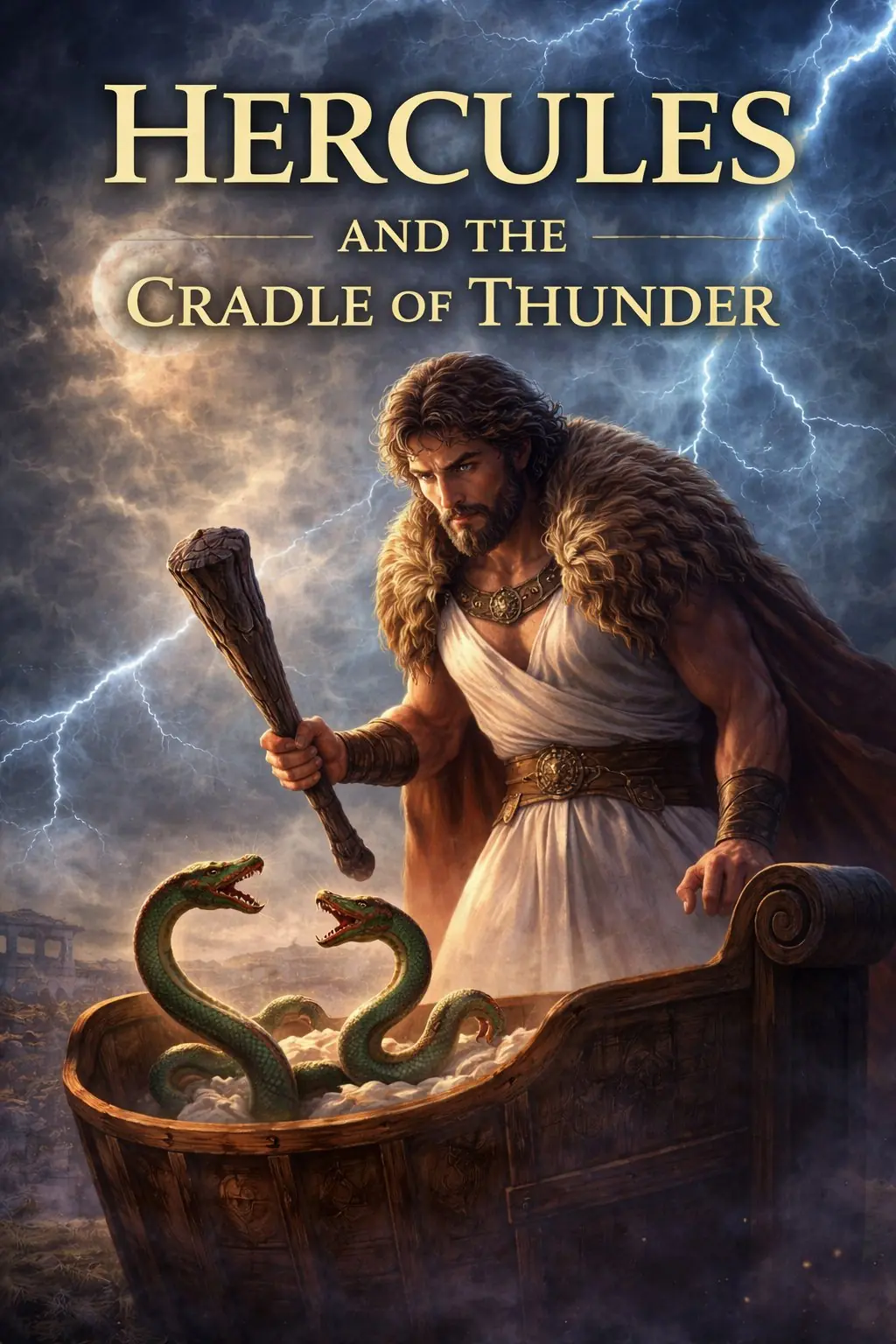 The labours as they actually happen — bare-handed, up close, human. That’s my novel Hercules and the Cradle of Thunder. Read it on Amazon →
7. The Cretan Bull
The bull Minos had failed to sacrifice went mad and trampled Crete, and the task was to bring it back alive. Hercules wrestled it down, carried it off, and turned it loose near Marathon, where it kept trampling the countryside until Theseus finally killed it (someone always inherits Hercules's leftovers). Read the full account →
8. The Mares of Diomedes
Diomedes of Thrace fed passing strangers to his four horses, which had grown savage on the diet. Hercules ended the practice in the plainest way the sources allow: he fed Diomedes to them. (Full essay coming soon.)
9. The Belt of Hippolyta
Sent for the war-belt of the Amazon queen, Hercules met with no fight at first — Hippolyta, by most accounts, simply offered it. Then Hera, moving among the Amazons in disguise, spread word of a kidnapping, and what should have been a gift ended as a battle. (Full essay coming soon.)
10. The Cattle of Geryon
At the western edge of the world he killed Geryon, a warrior with three bodies joined at the waist, along with his herdsman and his dog, and drove the red cattle home. He marked the outward journey by setting the two pillars that still carry his name. (Full essay coming soon.)
11. The Apples of the Hesperides
The golden apples were kept by a sleepless dragon in a garden no one could find, so Hercules took the weight of the sky onto his own shoulders and sent Atlas to fetch them. Atlas came back with the apples and offered to deliver them himself, sky and all, which would have left Hercules holding the heavens forever. Hercules agreed — he just needed a moment first to pad his shoulders against the weight, he said, and could Atlas take the sky back for one minute while he did. Atlas took it. Hercules picked up the apples and walked away (the oldest trick in the book, and it worked). (Full essay coming soon.)
12. Cerberus
The last labour sent him to bring up the hound that guards the dead, and Hades agreed on one condition: that he take the animal using no weapon at all. He carried Cerberus into the daylight, showed him to Eurystheus, and carried him back down. Read the full account →
The labours are the middle of the story, not the whole of it. Before them is the cradle, where Hera sent her first two snakes; after them is a shirt that finally did what no monster had managed. Four of the twelve — the mares, the belt, the cattle, and the apples — are not yet set down here on the blog, and all of it, from the first serpent to the last, is told in full in the novel.
Hercules and the Cradle of Thunder
The full story of Hercules — the cradle, the madness, the twelve labours, and the pyre on Mount Oeta.