Where the Bull Came From — and Why It Went Mad
The Cretan Bull was not born a monster. Poseidon sent it to King Minos of Crete as a perfect white bull from the sea, intended as a sacrificial offering. The protocol was understood: a king receives a divine gift, acknowledges the god's power, and returns the gift through ritual. Minos looked at the bull — enormous, white, without blemish — and decided it was too beautiful to kill (kings in this mythology have a habit of rating their own taste above a god's instructions). He substituted an inferior animal and kept the white bull for himself.
Poseidon, who had created the bull and knew exactly what had happened, arranged a different kind of punishment. The god did not strike Minos down. He did not take the bull back. He made Minos's queen, Pasiphae, fall in love with the animal. The mythology is specific about this in a way that is uncomfortable to read and clearly intended to be. The results were the Minotaur — half bull, half man, hidden in the labyrinth that Daedalus built underneath the palace at Knossos. The white bull, meanwhile, was driven mad by the same divine displeasure that had infected the whole situation. It began destroying the island. By the time Eurystheus assigned it to Hercules as the Seventh Labour, it had been terrorising Crete long enough to become a political problem.
This is the backstory sitting beneath what looks, on the surface, like a simple monster-catching story. The bull is not a monster in the way the Nemean Lion or the Lernaean Hydra were monsters — creatures of divine origin sent specifically to kill. It is something stranger: a sacrificial animal that became a catastrophe because a king made a decision that seemed minor at the time. The madness is contagious and retrospective. The island is still paying for what Minos chose, years after the choice was made.
The Seventh Labour — What the Fight Actually Looked Like
Hercules had never been to sea before. The crossing from the Greek mainland to Crete confirmed he was a man of land — the sea did not suit him and he did not pretend otherwise. He arrived in Crete, spoke briefly with Minos (who was glad to be rid of the problem), and went to find the bull.
The bull charged immediately. It was enormous and fire-breathing and it had been waiting for something to destroy. What followed was not a fight in any conventional sense — there were no weapons involved, because no weapon could have ended it. Hercules held on. The bull dragged him across three fields, through a vineyard, and into a barn that collapsed on both of them. The fire-breathing was a complication. It was not something Hercules had specifically prepared for, and the ancient sources do not give him a clever solution to it. He held on anyway — not because he had a plan, but because holding on was, at this point in his life, his most refined skill. He held until the animal had nothing left to give.
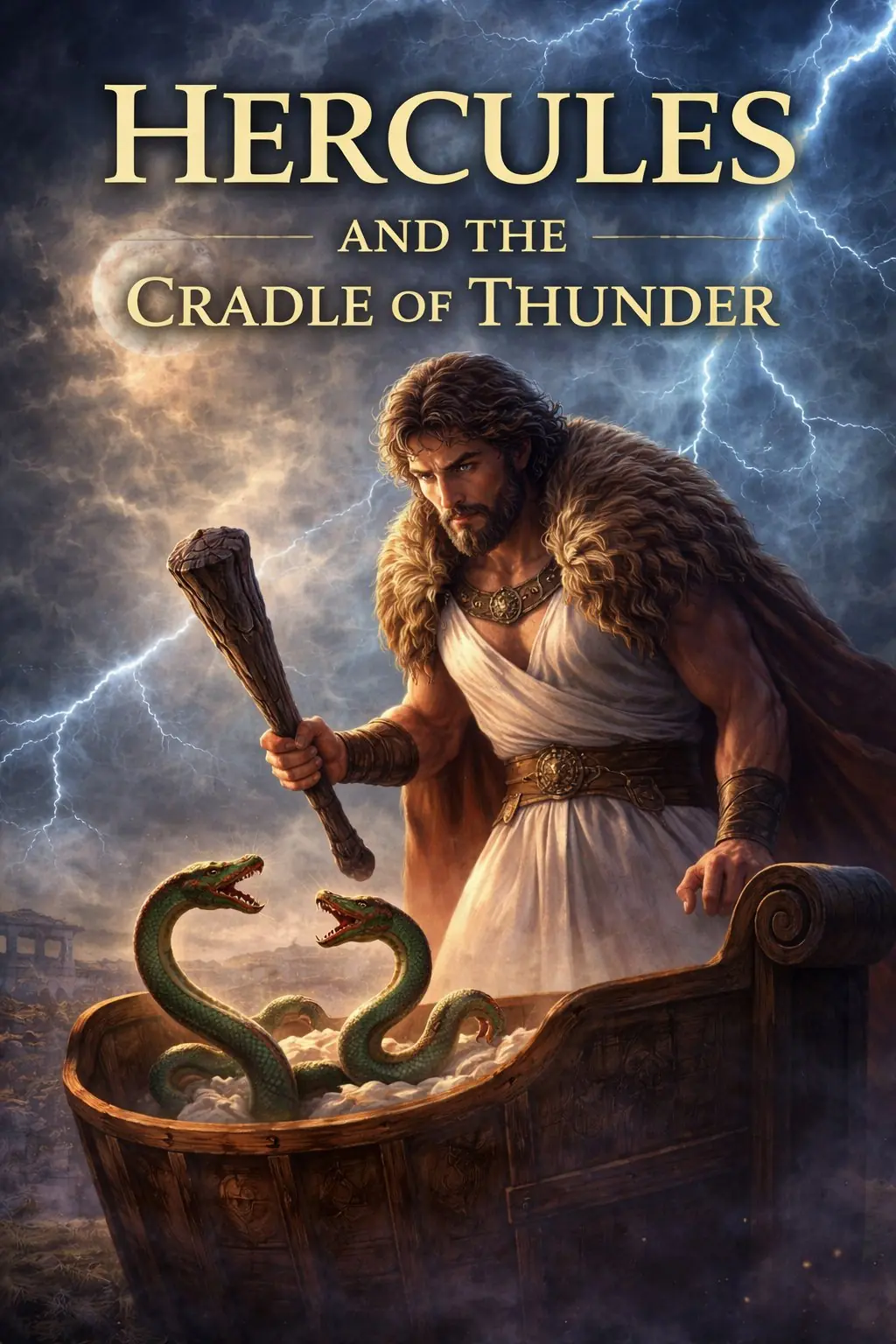 The labours as they actually happen — bare-handed, up close, human. That’s my novel Hercules and the Cradle of Thunder. Read it on Amazon →
Apollodorus records the capture without ceremony. Hercules grabbed the bull from behind, wrestled it to submission, and brought it back to Eurystheus on the Greek mainland. Eurystheus, who had previously hidden in a bronze jar underground when Hercules returned from the Erymanthian Boar Labour (a scene ancient vase painters clearly could not resist repeating), did not hide this time. The bull was alive and breathing fire, and Eurystheus wanted nothing to do with it. He released it. This was a consistent pattern in the Labours: Eurystheus assigned the tasks, was horrified when they succeeded, and immediately found reasons to disclaim the results. The Hydra heads were brought to him; he disqualified the Labour because Iolaus had helped. The stables were cleaned; he disqualified it because Hercules had accepted payment. The bull was caught and delivered; he let it go. The scoring system was designed to fail Hercules regardless of what he did.
What the Bull Did Afterward — Greek Mythology's Long Memory for Animals
The Cretan Bull did not disappear after Hercules released it. Released near Tiryns, it wandered north through the Peloponnese, crossed the Isthmus of Corinth, and eventually settled near Marathon in Attica, where it became known as the Marathonian Bull. It continued causing damage. Years later — while Hercules was still alive, partway through the rest of the Twelve Labours — Theseus came to Marathon and captured the bull. He paraded it alive through the city and sacrificed it to Apollo at the Delphinium, long before the Trojan War would even begin.
This connection matters more than it might appear. The Cretan Bull is the father of the Minotaur, who is the creature Theseus later kills in the labyrinth at Knossos. Theseus's relationship to the bull runs in both directions: he captures and sacrifices the father, then descends into the dark to kill the son. The mythology keeps careful records of these relationships across generations (a courtesy Eurystheus never extended to Hercules, whose own scorecard got rewritten after every Labour). The animal that Minos kept instead of sacrificing eventually required two acts of killing to settle the account — one by a hero from Tiryns, one by a hero from Athens, separated by years and framed as entirely different stories.
The bull's journey from Crete to Marathon is also, in miniature, the shape of how the Greek world worked in mythology: things sent from the gods move across the landscape, touch multiple stories, and leave traces in each one. The Cretan Bull is not a contained episode. It is a thread that passes through the fabric of the mythology and can be found again, pulling taut, decades later in a different place with a different hero standing over it.
Hercules and the Cradle of Thunder
Book Two of the Myths of the Ancient World series. The complete arc of the Twelve Labours — from the Nemean Lion to Cerberus — told through the ancient sources, not the Disney version. Including what happened to the Cretan Bull after Hercules let it go.
Also on the blog: