The Mission That Could Not Succeed
Cadmus was a Phoenician prince—eldest son of Agenor, king of Tyre. His story begins with his sister Europa's abduction by Zeus in the form of a white bull (subtlety was never his strength). Agenor sent his sons to find her. The command: return with her, or do not return at all. This is the first impossible instruction Cadmus receives, and the myth of Thebes is the story of what a man does when only impossible instructions are on offer.
He searched for five years. He could not find Europa, because she was in Crete with a god, beyond any mortal search. He went to Delphi. The oracle told him to stop looking for his sister and instead follow a cow with a moon-mark on her flank to wherever she lay down, and build a city there (Delphi rarely gave an answer that matched the question). This is the second impossible instruction: abandon the mission, and follow a cow instead.
Cadmus followed the cow. It led him to Boeotia.
The Dragon, the Teeth, and the Sown Men
The founding of Thebes required one more thing. Cadmus sent men to a nearby spring, and they did not return. He went himself, found his companions dead, and killed the dragon of Ares that had killed them. Athena appeared and told him to sow the dragon's teeth in the earth. From the teeth rose the Spartoi—fully armed warriors who fought each other until five remained. These five became the founding noble families of Thebes.
Here is the detail most retellings leave out. Athena split the dragon's teeth in half. One half went into the Theban soil and grew the Spartoi. The other went to Aeetes, king of Colchis, who later gave it to Jason for an impossible task of his own: yoke fire-breathing bulls, plow a field, and sow the teeth to reap a crop of earthborn men. One dragon, two harvests (Apollonius Rhodius, Argonautica; poets rarely mention the other).
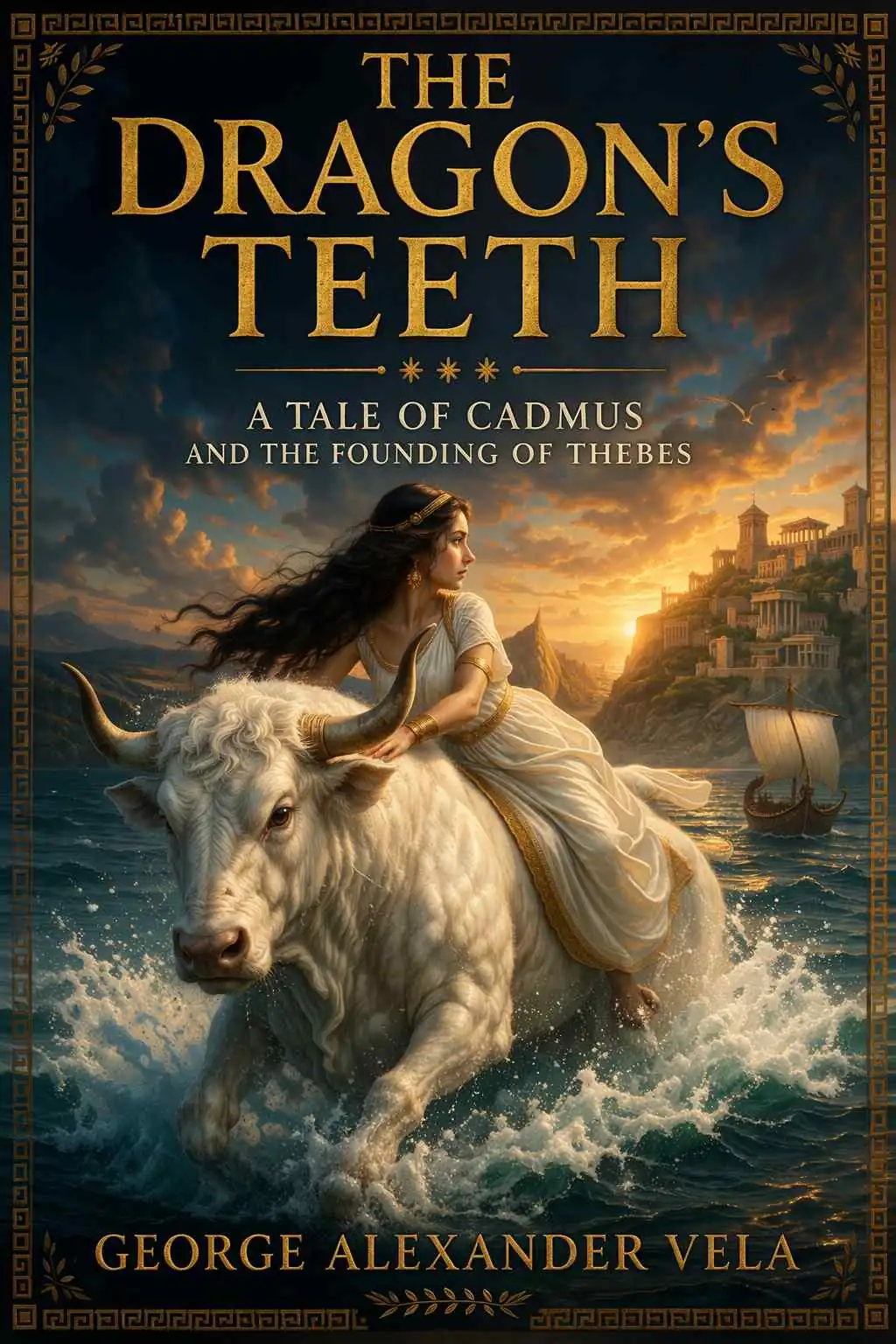 Cadmus, the serpent, and the city grown from its teeth. That’s my novel The Dragon's Teeth. Read it on Amazon →
For killing a creature sacred to Ares, Cadmus served the god for eight years. At the end of that service, he received Boeotia and Harmonia—the daughter of Ares and Aphrodite—as his wife. All the Olympians attended the wedding. The Muses sang. Hephaestus gave a necklace. The city of Thebes was formally established on the plain where the cow had lain down.
The Founder Who Could Not Stay
Cadmus and Harmonia lived to see their city established, their children grown, and their grandchildren begin the destruction that would define Thebes for the rest of its mythological history. Agave tore her son Pentheus apart with her own hands in a god-sent frenzy. Semele was destroyed by a god's glory. Ino went mad. The grief of watching what you built be unmade by the people you made it for is a particular kind of ruin, and the myth handles it without euphemism.
In old age, Cadmus and Harmonia left Thebes for Illyria. There, in a moment the ancient sources do not describe in detail but all record, they were transformed into serpents—a pair of snakes, carried to the Isles of the Blessed. The man who had sown dragon's teeth and grown warriors from the earth became, at the end, something that looked like what he had killed at the beginning. This is either coincidence or the myth's way of completing a circle. In Greek mythology, those two things are rarely different.
The Dragon's Teeth
Book Five of the Myths of the Ancient World series. The complete myth of Cadmus—from Tyre to Thebes, from the dragon to the transformation.
Also on the blog: