The Morning Europa Vanished
The morning Europa vanished began like any other: sunlight on the water, warm sand, nothing to mark it as her last ordinary day. Then a white bull rose from the sea—impossible white, brilliant white, the white of something that had spent eternity in deep water and only now walked onto land. Its eyes were the color of the sky before a storm. She was a princess of Tyre, daughter of Agenor, king of Phoenicia (not that any of that mattered to the bull).
It was Zeus in disguise—the king of the gods, wearing a bull the way another man wears a coat. The poets never explain why the costume was necessary. They don't apologize for it. Europa, drawn by the animal's beauty and its gentleness, climbed onto its back. The sea swallowed them both. On the beach: nothing but hoofprints in the wet sand.
Zeus carried her to Crete. She bore him three sons—Minos, Rhadamanthus, and Sarpedon—who became great kings and judges. Her family in Tyre never heard from her again.
The Father's Command
Agenor, Europa's father and king of Tyre, searched every harbor. When there was nothing to find, he summoned his sons. What he said was not a request. Find her, or do not return to me. (Agenor was not, on that particular morning, a subtle man.) The command came in the voice of a king who has nothing left to lose—the most dangerous voice there is.
Cadmus was the eldest, twenty-two years old, not by nature a worrier or a pessimist. He searched the coasts of Phoenicia, then the islands, then the mainland of Greece. Five years passed. He never found her, because she was on Crete with a god, and no mortal search was ever going to reach that far.
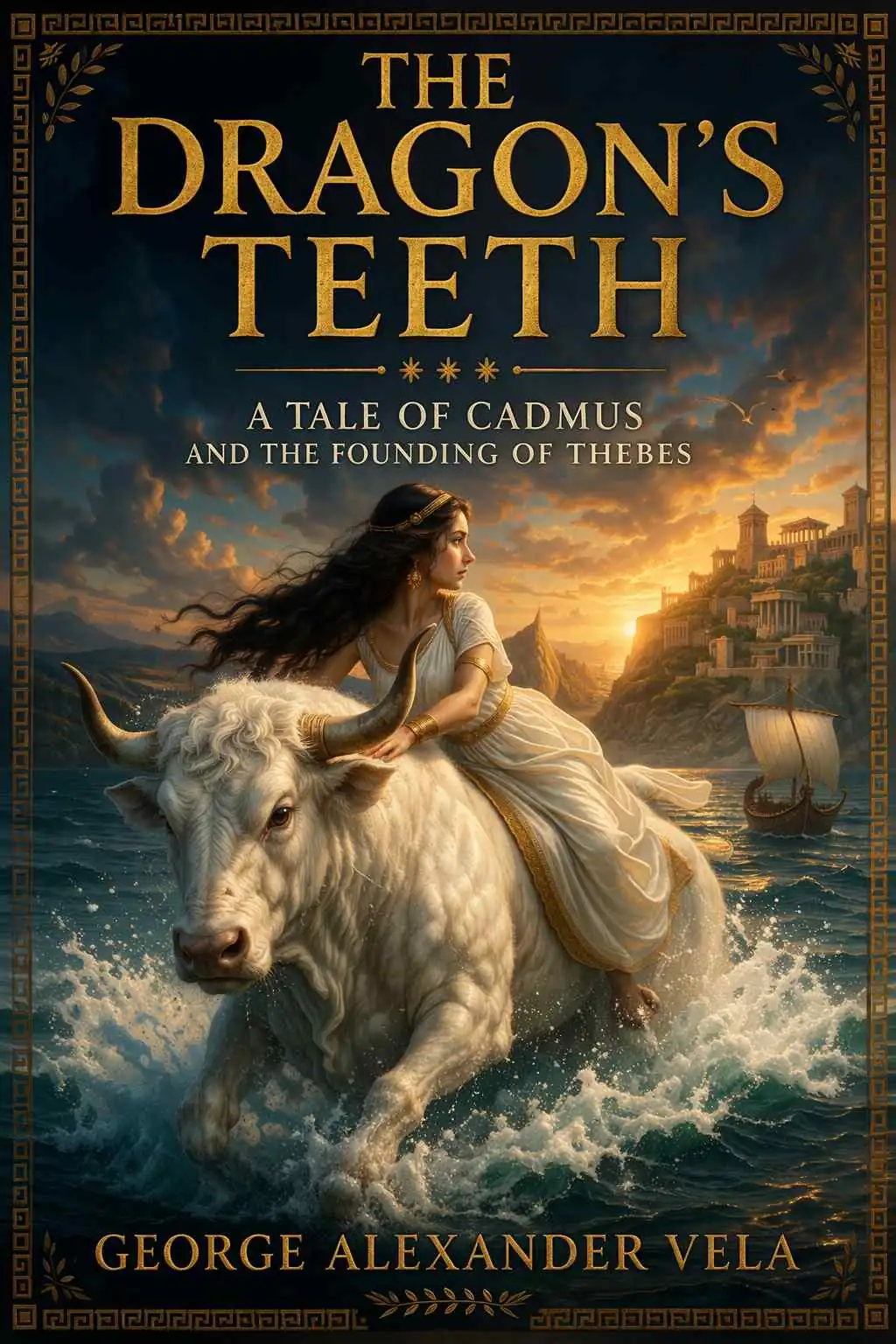 Cadmus, the serpent, and the city grown from its teeth. That’s my novel The Dragon's Teeth. Read it on Amazon →
The order his father gave him was impossible on its face, and the myth never pretends otherwise. Cadmus had been sent after something he could not retrieve, told he could not come home without it, and left to work out what a man does next.
How the Myth of Thebes Begins
The founding of Thebes does not begin with a hero's ambition or a god's plan. It begins with a missing girl and a father's grief, translated into an order no one could carry out. Cadmus eventually gives up the search—not from laziness but understanding: a god had taken his sister, and no coastline walk would bring her back. So he does something stranger: he goes to Delphi and asks the oracle what to do instead.
The oracle's answer has nothing to do with Europa. Stop searching, it tells him: find a cow marked with a crescent moon, and build a city wherever it finally lies down to rest (Delphi's oracles specialized in cryptic, not helpful—see every other oracle story in this canon). Cadmus finds the cow, follows it across country, and watches it drop from exhaustion in a field in Boeotia. That field becomes Thebes.
Europa never comes home. She stays on Crete, raises three sons who become kings, and gives her name—in most ancient traditions—to an entire continent. Her brother spends five years chasing a woman already gone, then spends the rest of his life building the city he found instead. Somewhere between those two facts is the actual myth.
The Dragon's Teeth
Book Five of the Myths of the Ancient World series. The myth of Cadmus—the founding of Thebes, the dragon's teeth, and the city built from impossible instructions.
Also on the blog: