The Spring of Ares
The spring Cadmus's men were sent to was not a well you dig and forget. It was the Spring of Ares—sacred to the god of war, sunk into a grove, guarded by something older than the region's name. The sources can't agree on what it looked like: enormous, serpentine, crested in gold, breathing poison—take your pick (the poets loved this dragon, and none of them had actually seen it). What they do agree on is its age. It had been guarding that water longer than any city nearby had existed.
The sound it made, some sources say, wasn't a roar. It was lower than that, and worse: the grinding of something huge dragging itself over stone, built to plant one specific fear. Not the fear of a sudden strike. The fear of a thing that had been there long before you showed up, and would still be there long after you were gone.
The Companions Lost
Cadmus sent five of his men—companions who had followed him from Tyre, who had spent five years searching the Mediterranean coast, who had walked with him to Delphi and followed the cow across Boeotia. They went to the spring. They did not come back.
Cadmus sent five more. Same result—nothing.
Somewhere between the second silence and the decision to go himself, Cadmus stopped hoping and started arming. He waited what the texts call a long time—long enough, it's fair to guess, to rule out bad luck. Then he took up his lion's skin, his spear, and the great stone he carried as a weapon (gear for a fight, not an errand), and went to see for himself.
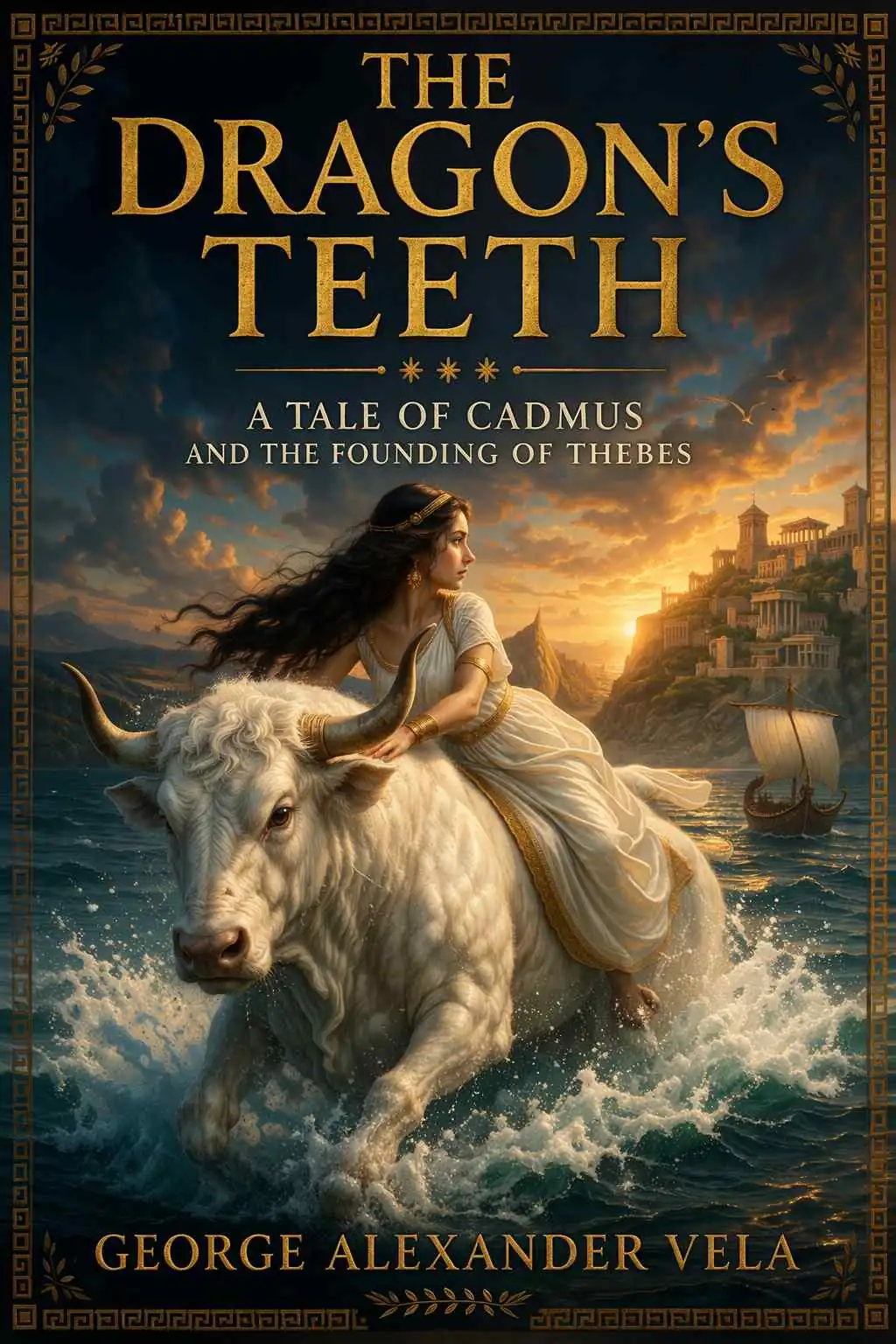 Cadmus, the serpent, and the city grown from its teeth. That’s my novel The Dragon's Teeth. Read it on Amazon →
What He Found
The spring was there. His companions were there too, in pieces, scattered along the path to the water. And the dragon was still there—not fled, not sated and asleep somewhere else, just waiting (why would it leave; nothing yet had given it a reason to).
What Cadmus faced was not simply a large dangerous animal. It was the guardian of something sacred to a god who hadn't given him permission to be there. The founding of Thebes ran straight through this creature—the oracle had sent him to this exact plain, this exact spring, with no going back to Delphi for a second opinion. The spring was the spring. The dragon was in the way.
What most retellings skip is what came after. Cadmus didn't just win and walk away to found his city. Killing something sacred to Ares came with a bill, and he paid it in person: Apollodorus says he served Ares for what the text calls "an eternal year," which the same source clarifies was eight years by ordinary reckoning. Athena got him his city. Ares got eight years of his life first. The poets love the teeth Cadmus sowed and the warriors who rose from the ground; they're quieter about the decade he spent afterward, paying off the god whose pet he'd just killed.
The Dragon's Teeth
Book Five of the Myths of the Ancient World series. The myth of Cadmus—the dragon, the teeth, and the city that grew from them.
Also on the blog: