The Fight at the Spring
Here is the fight, and it is not the single clean strike most retellings imply. Cadmus finds his companions dead at the spring and throws the first rock he can lift—a stone heavy enough to level a wall. It hits the dragon's hide and does nothing (Ovid says so plainly: the scales hold like armor). So he throws his spear instead. The head sinks into the fold of the creature's back, deep enough to hold. The dragon thrashes and backs itself straight into an oak. Cadmus follows the retreat, driving the same spear through until the point comes out the far side of its throat, nailing the animal to the trunk. One weapon, no second strike, and no sword, whatever the movies claim.
The fight took everything he had, and no one saw it happen. His companions were already dead. He was alone at a spring sacred to a god of war who had not been asked, in a grove far from any city, with no witnesses and no record kept.
What Athena Told Him to Do
When the dragon was dead, Athena appeared. She had been watching, it seems (goddesses of strategy rarely miss a good fight, and rarely lift a finger during one). Her instructions for the corpse were specific and strange: pull the teeth from its jaw, and sow them in the ground the way a farmer sows grain.
This is the instruction that gives the myth its name. The Dragon's Teeth are not a metaphor bolted on for effect—they are the mechanism itself. What grows from them is what Thebes is made of. Cadmus did not import citizens from Phoenicia or recruit them from the nearby towns. He grew them out of the ground, from the teeth of the thing that had just killed his friends, on the say-so of a goddess who showed up only after the hard part was finished.
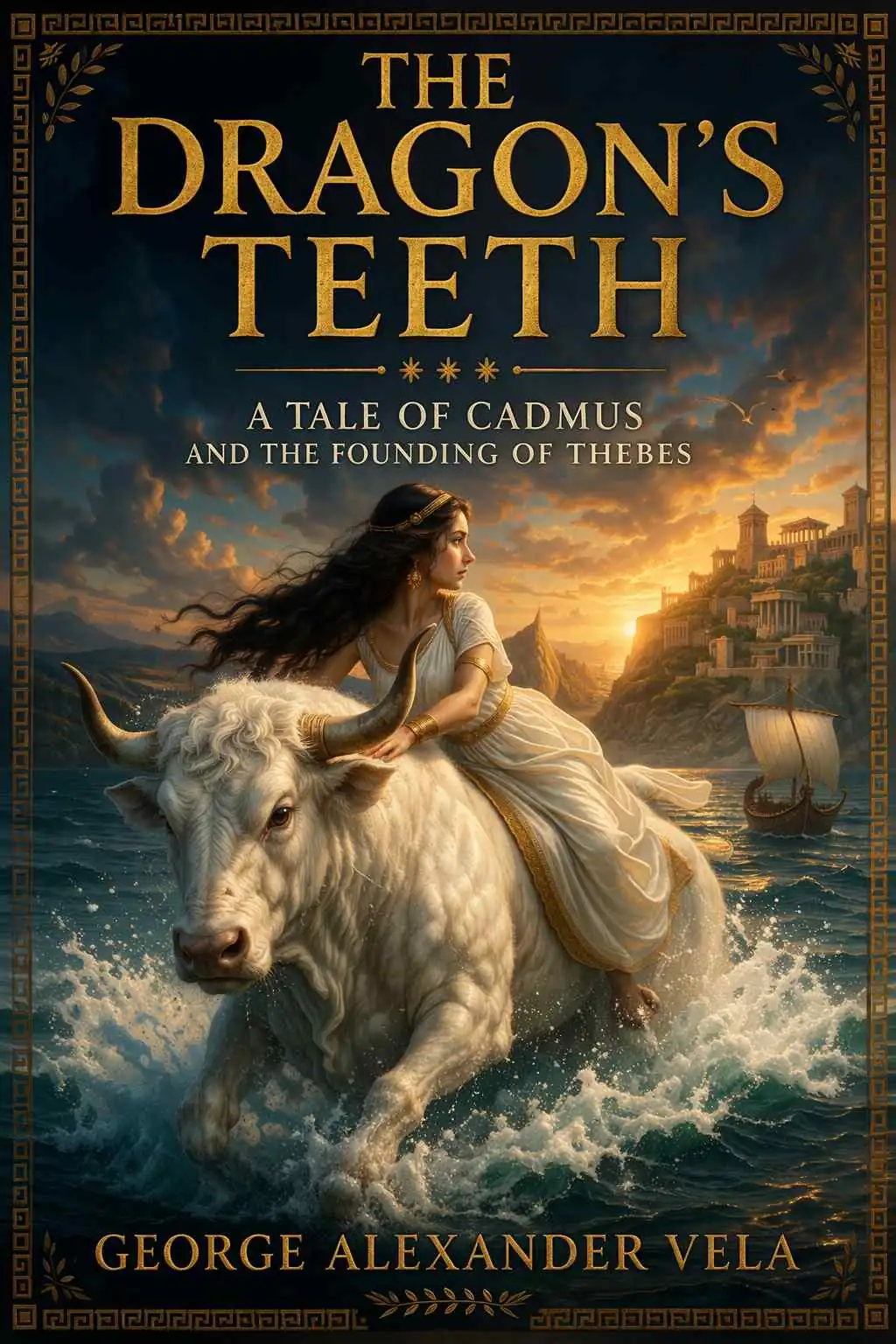 Cadmus, the serpent, and the city grown from its teeth. That’s my novel The Dragon's Teeth. Read it on Amazon →
The Eight-Year Service
Killing the dragon, however necessary, was still an offense against Ares—the creature had been his. The gods rarely let that kind of thing slide, justified or not (mercy was never really their department). Cadmus paid for it in service: eight years to Ares, a full "great year" by the old reckoning, the length of a human generation folded into one long stretch of penance.
He served it out. Athena then gave him the region of Boeotia. Zeus gave him Harmonia, daughter of Ares and Aphrodite, for a wife—which meant the god whose dragon Cadmus had killed became his father-in-law. It was the only mortal wedding every Olympian showed up to in person (their attendance record for human affairs is otherwise dismal). The city that rose out of those eight years was Thebes, built exactly where the cow had lain down, beside a spring that still ran clear, over ground that still held a dragon's teeth.
The Dragon's Teeth
Book Five of the Myths of the Ancient World series. The myth of Cadmus—the founding of Thebes from the first oracle to the last transformation.
Also on the blog: