What Hera Did — and Why
Zeus fathered the child by disguising himself as Alcmene's own husband, Amphitryon — a trick that worked on Alcmene but never, for one second, on Hera. When she found out, her anger did not fade once the baby arrived. It sharpened. According to Apollodorus's Bibliotheca (2.4.8), she sent two enormous serpents into the nursery while the household slept.
The detail most modern retellings compress or omit: these were not small snakes. Apollodorus describes them as enormous. Their combined length could have encircled the room. They moved, as the ancient sources put it, with purpose.
Alcmene was there. Amphitryon was there. The household was sleeping. The serpents entered through the nursery window.
The Infant's Response
What happened next is the founding image of Hercules in the ancient tradition — the moment that established, before any labour or any heroism, what kind of thing had been born.
Pindar, writing in the fifth century BCE, tells the story in Nemean Ode 1: the serpents entered, and the infant Hercules — called Alcides at this point, before the Pythia renamed him — sat up in the darkness and strangled them. Both of them. One in each hand. The killing was, by all accounts, effortless (Pindar wants you to notice that, not the size of the snakes). The infant did not fight the snakes. He simply held them until they stopped moving.
His twin brother, Iphicles — Amphitryon's biological son, the same age, same cradle — screamed and ran (the sane response, it should be said, to two enormous snakes in your bed). The distinction between the twins is set in this one scene: one child answers the threat with terror, which is the correct human response. The other answers with a kind of terrible, unconscious competence that nobody in the room yet knows how to name.
What the Seer Said
Pindar does not end the scene with the strangling. He continues: Amphitryon, hearing the noise, came running and found his stepson sitting upright in the dark, a dead serpent in each fist. And here, for once, the poets go quiet — Nemean 1 never says the child looked triumphant, or relieved, or afraid. It just moves on to the prophecy, as if the one detail everyone actually wants were the one detail nobody thought to write down.
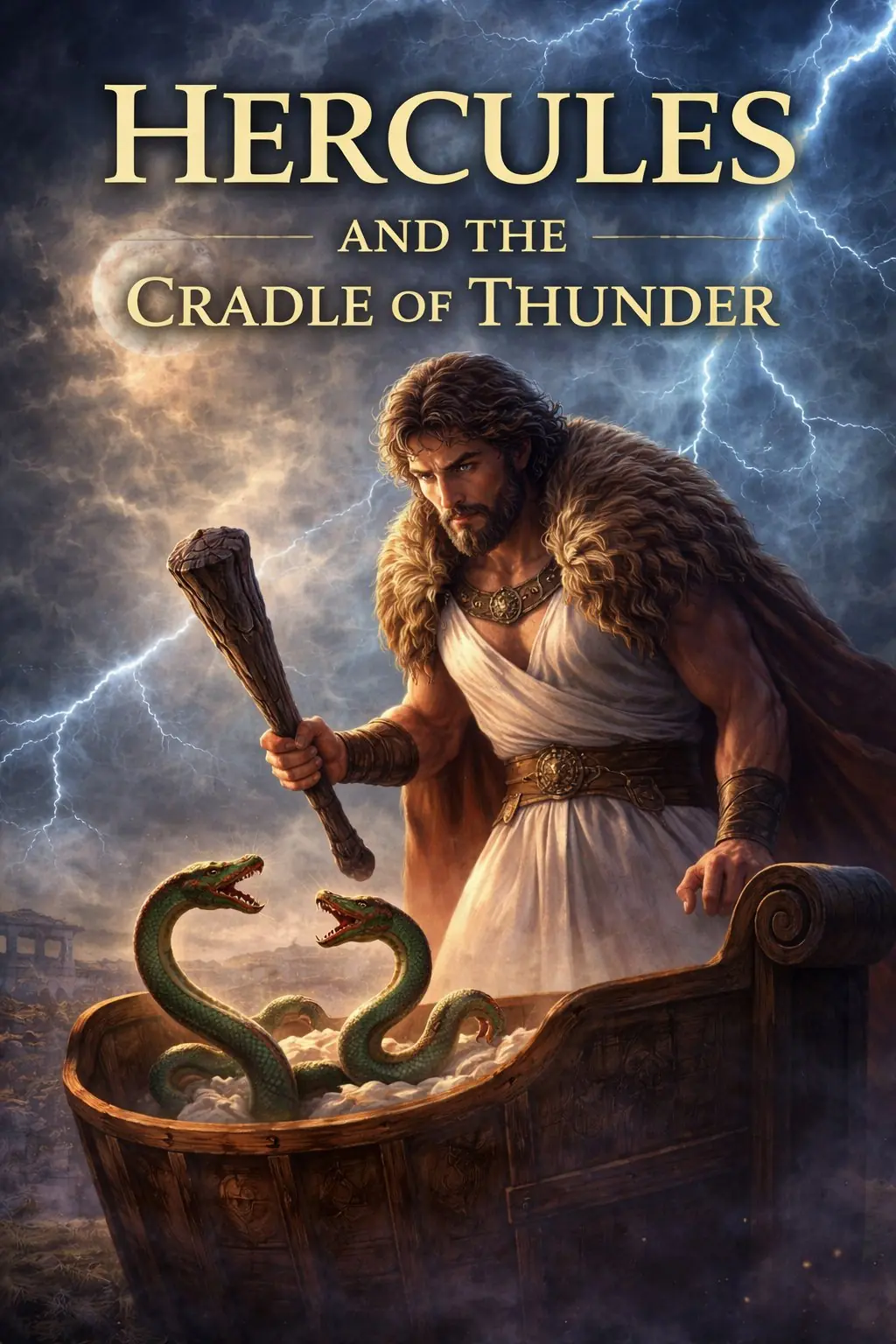 The labours as they actually happen — bare-handed, up close, human. That’s my novel Hercules and the Cradle of Thunder. Read it on Amazon →
The seer Tiresias was summoned. In Pindar's telling, Tiresias took the child and spoke for a long time — predicting every monster Hercules would eventually kill, every labour that lay ahead, the war at Troy, the defeat of the giants on behalf of the gods. He spoke the child's entire future in the darkened nursery, while Alcmene stood listening, while the dead serpents lay on the floor.
Diodorus Siculus, writing in the first century BCE, gives the same essential account in Bibliotheca Historica 4.10. The detail he adds: the strangling of the serpents was the first proof to the household that the child was something other than what they had assumed. Not a god — Hercules is mortal throughout his myth, and this is part of the point — but something for which the category "mortal" was not quite accurate either.
The Name He Was Given — and the One He Was Born With
Hercules was not his birth name. Apollodorus records (2.4.12) that the infant was originally called Alcides, after his grandfather Alcaeus. The name Hercules — Heracles in the Greek — was given to him later, when Alcmene consulted the Pythia at Delphi about what the serpent episode meant for her son's future.
The name Heracles is usually interpreted as "glory of Hera." Read one way, that's an irony so complete it becomes its own kind of meaning. Read the other way, it's a deliberate theological claim: that even Hera's hostility became, in the end, the force that made him. Without the serpents, there is no cradle scene. Without the cradle scene, there is no first proof of what he could do. Without that proof, the labours make less sense — they are not given to a man already known to be capable of them, but to one who still has to prove it.
The serpents were not an obstacle he overcame. They were the first announcement of what he was.
Hercules and the Cradle of Thunder
The full story of Hercules — from the night the stars went silent over Thebes to the pyre on Mount Oeta — in a single novel of literary Greek myth.
Also on the blog: