Before the Labors, There Was a Cradle
The myth of Hercules is usually filed under the twelve labors (the lion, the hydra, the stables—pick your favorite). But the story starts earlier, in a room in Thebes, before the boy could walk or talk. To understand why the labors happen at all, you have to understand what Hera already knew about this child before he was old enough to be afraid of anything.
Hercules was the son of Zeus and Alcmene, a mortal woman Zeus visited by disguising himself as her husband, Amphitryon. Hera, Zeus's wife, found out. Her hatred for the child wasn't merely personal—it was structural. Hercules, by existing, made Zeus's infidelity permanent and visible. She could not undo him. What she could do was try to destroy him before he became what Zeus intended.
The name Hercules is itself an attempt at appeasement. It means ‘glory of Hera'—a name given in hope that the goddess might relent. She did not.
The Night the Serpents Came
Alcmene laid her infant sons in a bronze shield she used as a cradle—Hercules and his twin half-brother Iphicles, son of the mortal Amphitryon. That night, in the version everyone tells, Hera sent two serpents into the dark room to kill them both while the household slept.
Iphicles screamed (the reasonable reaction, honestly). Hercules reached out and took a serpent in each hand. By the time Amphitryon burst in with a sword and a torch, the infant had already strangled both of them and sat among the bodies looking pleased with himself. The seer Tiresias, when consulted, told Amphitryon what it meant: this child would face trials no mortal could survive, and survive them anyway.
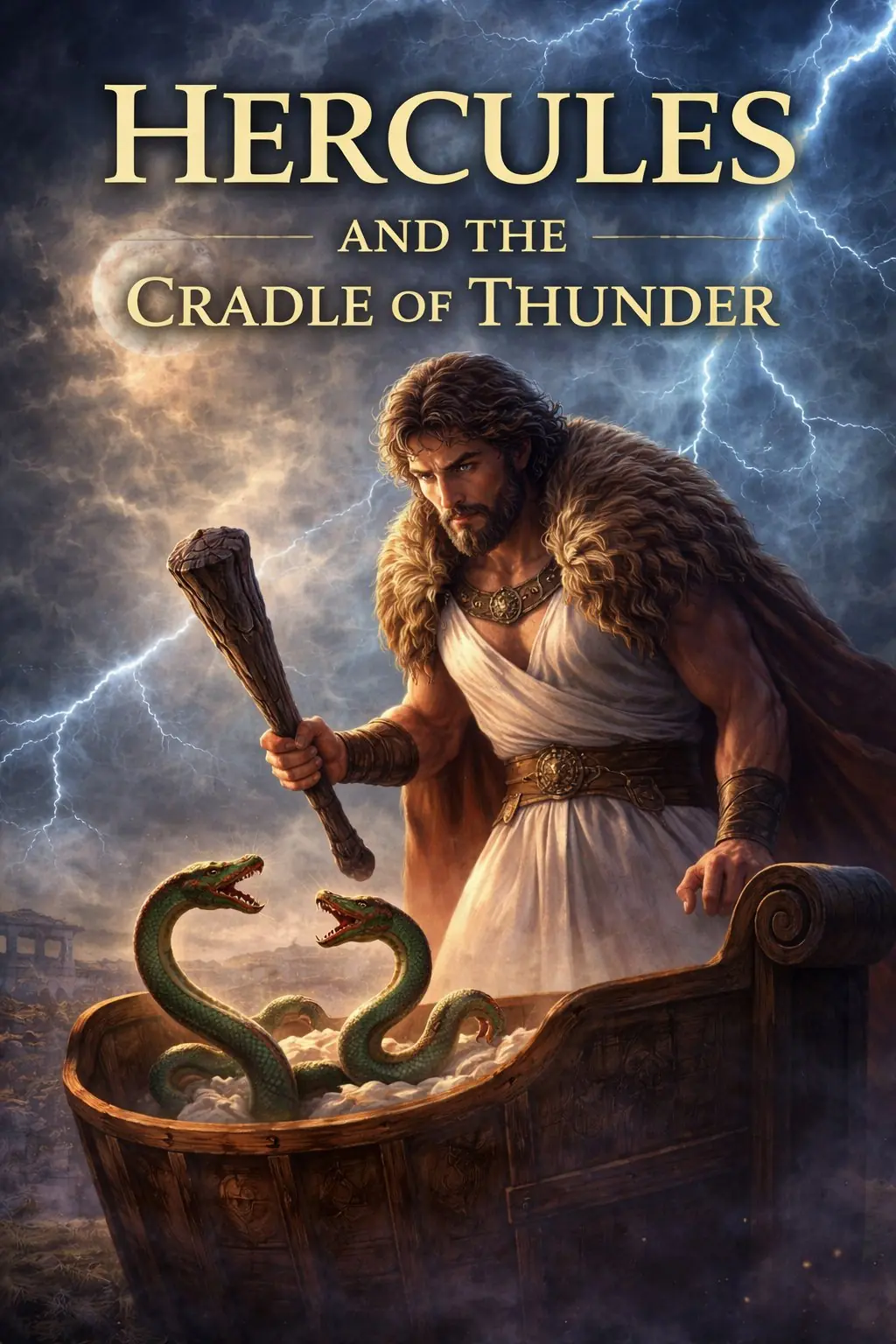 The labours as they actually happen — bare-handed, up close, human. That’s my novel Hercules and the Cradle of Thunder. Read it on Amazon →
The detail that matters is not the strength. It is the absence of fear. Iphicles reacted the way any child reacts to a threat—panic, helplessness. Hercules did not. Whatever it was in him that would later wrestle the Nemean Lion bare-handed was already there, fully formed, in an infant who looked at two venomous snakes as if they were toys.
What the Cradle Really Proves
The myth is often read as a story about strength. The cradle scene argues for something else: a person who meets mortal danger without the hesitation mortal danger is supposed to produce. That is not recklessness. Hercules does not charge at things he does not understand. He simply does not flinch the way everyone else flinches.
Here is what most retellings leave out. Not every ancient source blames Hera for the serpents at all. Pherecydes and the old scholiasts on Pindar tell it differently: Amphitryon put the snakes in the cradle himself, testing his two infant sons to learn which one was actually his. (Not the tenderest method available to a new father, but the ancients were unsentimental about how they got their answers.) If that version is the true one, the scene is not a goddess hunting an infant. It is a mortal man solving a paternity question with live venom—and getting, instead of an answer about his wife, proof that he was raising something no snake could kill.
Whichever version is true, Hera's campaign against Hercules did not end at the cradle—whether she sent the serpents herself or only inherited the grudge afterward. The twelve labors are, in one reading, the same project continued by other means: if you cannot kill him directly, arrange the circumstances so that his own nature does it for you. Put the most dangerous things in the world in front of a man who will not back away from the most dangerous things in the world, and wait.
Hercules and the Cradle of Thunder
Book Two of the Myths of the Ancient World series. The twelve labors from the first serpents in the cradle to the final labor on the shores of the western sea.
Also on the blog: