The Oldest Procedural in Western Literature
Thebes has a murderer loose in it, a plague killing everyone who isn't the murderer, and a king who has sworn publicly, in front of witnesses, to find the man responsible and exile him. The king assigns himself the case. This is, structurally, the oldest procedural in Western literature, and Sophocles staged it in Athens around 429 BC without once tipping his hand that the detective and the killer share a name.
He does what any investigator does when a case refuses to close cleanly: stops trusting the easy witness, sends for the source everyone else was too polite to summon, and keeps pulling the thread after two people with more sense than him beg him to stop. A modern auditor recognizes the type — the one who finds the discrepancy in someone else's ledger and cannot let it go, not yet realizing the ledger is his own. The audience already knows, of course; that is the whole mechanism. Sophocles is not writing a mystery for them. He is writing one for the single man in the theater who does not get to be in on it.
What the Sources Disagree On
(Laius had heard the prophecy decades earlier and did what men with resources have always done with an unbearable piece of information: he outsourced it. A servant was told to expose the infant on Mount Cithaeron — a decision made the way a boardroom makes one, by people who will never watch it happen — and the servant, obedient rather than murderous, handed the child to a shepherd instead, which is the entire reason there was a case left to solve eighteen years later.)
Homer knew a smaller version. In Book Eleven of the Odyssey, Odysseus meets the shade of "Epicaste" — Jocasta, under an older name — and Homer disposes of the whole catastrophe in six lines: the gods made it known, she hanged herself in grief, and Oedipus, "suffering many pains," went on ruling Thebes afterward. No blinding, no exile. Sophocles is the version everyone remembers; Apollodorus's Bibliotheca, a handbook compiled centuries later to reconcile traditions rather than dramatize one, preserves the seam between them — the older Oedipus who stays king, scarred but functioning, and the harsher one whose self-discovery costs him everything at once. Both survive. Neither cancels the other out. That is the ordinary condition of a myth old enough to have been told by more than one kind of storyteller.
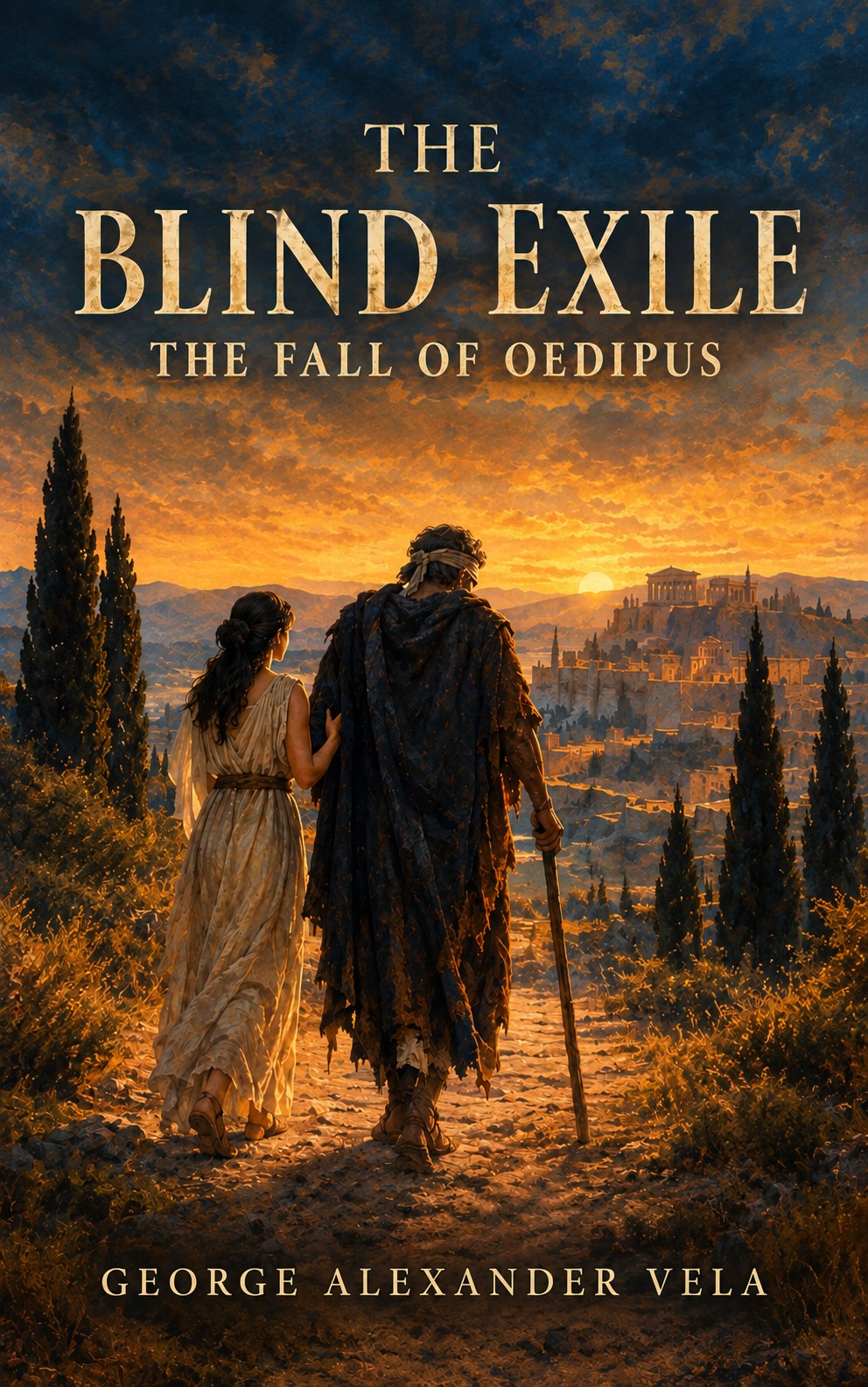 The investigation, the exile, and the walk to Colonus, in full. That’s my new novel The Blind Exile. Buy on Amazon →
The Play Sophocles Wrote Last
What almost nobody reads is the sequel. Sophocles wrote Oedipus at Colonus at the very end of his life, staged after his death around 401 BC. It picks up years on: an old, blind, ragged Oedipus, led by his daughter Antigone, arriving at a grove outside Athens — spending the years since exactly as the new book's title has him. Not a king in exile. Not a hero awaiting reinstatement. Just a blind man walked from city to city because no one wanted the trouble of housing Greece's most notorious patricide.
Then something strange happens, and it is why I kept going past the play everyone already knows. Theseus, king of Athens, receives him — not out of pity, but because an oracle has said whichever city holds Oedipus's grave will be protected forever. The man an entire play made untouchable becomes, in his last hours, the single most valuable resident in Attica. He dies without a body to bury, swallowed into the earth at a spot only Theseus is allowed to know, and the curse the audience was trained since childhood to flinch from becomes, at the very end, a gift.
Every book in this series closes with an Author's Note, and this one does the same work the others do: naming Sophocles, Homer, and Apollodorus, saying where the tradition splits, and owning which choices were mine to make. When a myth has more than one ending, the book says so — nine times before this one. It is the tenth case, and the evidence, once again, points somewhere most readers won't expect.
The Blind Exile: The Fall of Oedipus
Book Two of the Theban Cycle — the investigation, the exile, and the long walk to Colonus, told in the voice that has carried Myths of the Ancient World from the beginning. Available now on Amazon, free with Kindle Unlimited.
Also on the blog: