The Man Who Caught the Trick
When the call went out for kings and warriors to sail against Troy, Odysseus did not want to go. An oracle had warned him that if he joined the expedition, he would not see home again for twenty years. So when the recruiters reached Ithaca, they found their king plowing a field. He had yoked an ox to a donkey — an animal pairing that made no sense — and sown the furrows with salt instead of seed. A man that far gone in the head could hardly be expected to lead an army anywhere (or plow a straight line, for that matter).
The recruiter who did not believe it was Palamedes of Euboea. The ancient sources — Hyginus records the fullest version — give him a simple test. He took Telemachus, Odysseus's infant son, and set him down in the path of the plow. Odysseus swerved. A madman does not swerve to save a child he cannot recognize as his own. A sane man protecting his son does exactly that. The plow stopped. The madness stopped with it. Palamedes had his answer, and Odysseus had no cover left. He went to Troy.
That moment is worth pausing on. Palamedes did not humiliate Odysseus for sport. He exposed a deception that would have let one king sit out a war everyone else's sons were dying in. By every standard the army itself claimed to hold, he had done the right thing, publicly and correctly. Odysseus never forgave him for it. Nothing in the ancient tradition suggests Palamedes ever understood that he needed to.
What He Actually Built
Long before the war made him a target, Palamedes was already the closest thing the ancient tradition has to a culture-hero of pure invention. Gorgias — the sophist who wrote a defense speech in Palamedes's voice, imagining the case he never got to make at his own trial — has him list his own contributions with a craftsman's precision. Later writers filled in the rest.
He is credited with adding letters to the alphabet the Greeks used to keep records. That mattered in practical terms: an army camped on a beach for nine years needed to write dispatches, casualty lists, and rosters, not try to hold it all in memory. He is credited with the introduction of number and reckoning too — a system for counting men, rations, and ships that the army had not had before him. He is credited with weights and measures, and with the watch-order that let a camp sleep in shifts without leaving itself undefended. Then there is the detail every source enjoys most: he is said to have invented dice, purely to give bored, idle soldiers something to do with the dead hours of a siege that showed no sign of ending. Nine years is a long wait for a war; someone had to think of something. Later writers add lighthouses and beacon-signals to the list — a way for ships to find the coast, and for the coast to warn the ships.
None of this reads as legend inflating a minor figure. It reads as a portrait the Greeks kept adding detail to because the shape of it made sense to them. Here was a man who solved the army's actual, unglamorous problems — how do you count, how do you write it down, how do you get a fleet home in the dark — while other men were solving problems with a spear. Philostratus, writing centuries later in his Heroicus, still calls him the wisest and most just of the Greeks at Troy. That reputation survived nearly a thousand years of retelling. It did not survive the trial.
The Forged Letter and the Gold
The ancient accounts of what happened next agree on the shape of the plot, even where they differ on its exact mechanics. Apollodorus's summary and Hyginus's fuller version are the two that survive in most detail. Odysseus, unwilling to move against Palamedes directly, moved against him on paper instead. He forged a letter, written as though from Priam himself, thanking Palamedes for agreeing to betray the Greek camp to Troy in exchange for gold. He then arranged for a Trojan prisoner to be found carrying it — or for it to turn up among Palamedes's own effects; the sources vary on the staging. And he had gold quietly buried under the floor of Palamedes's tent, enough to match the sum the letter named.
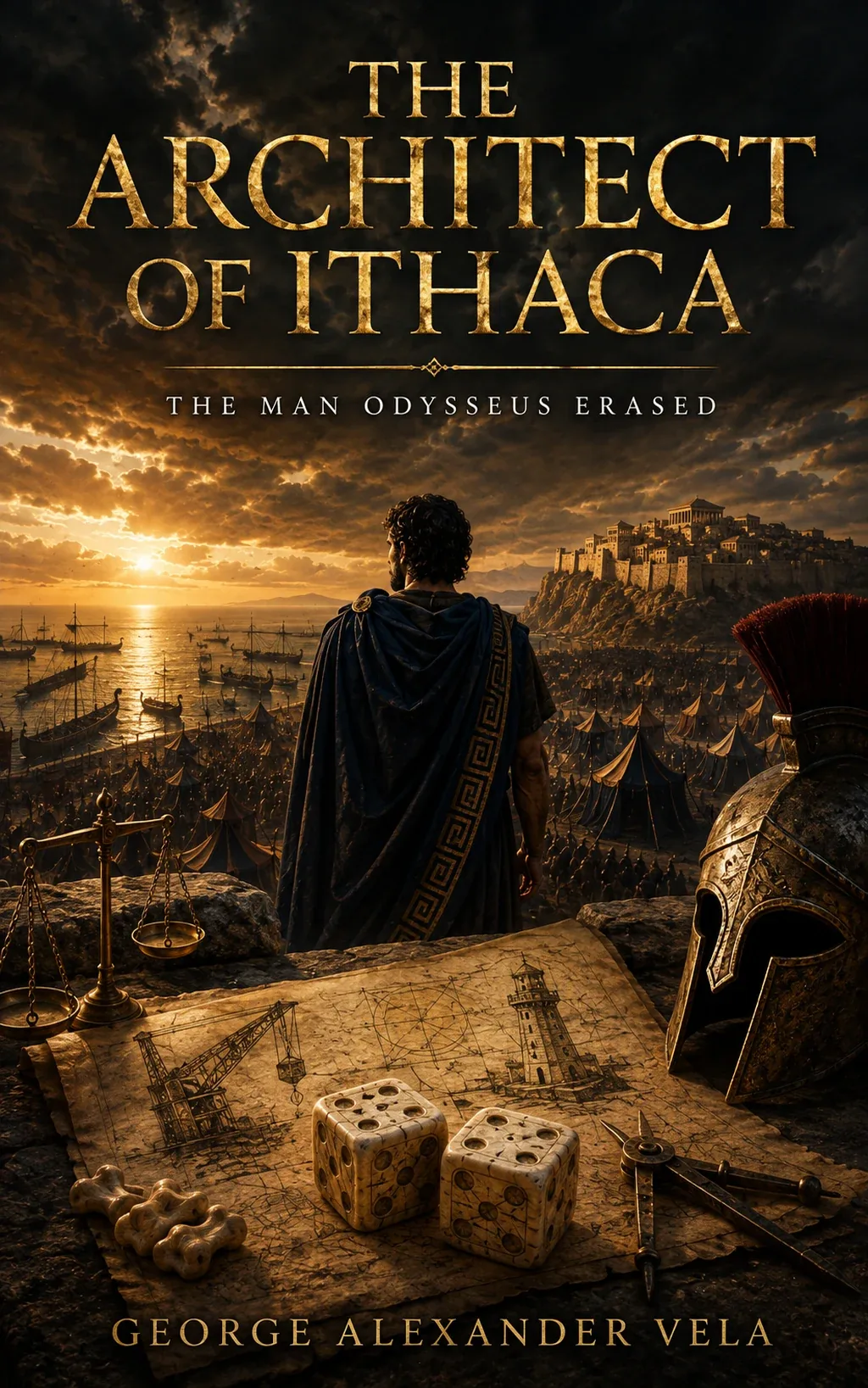 This is the trial and the man behind it, in full. That’s my novel The Architect of Ithaca. Read it on Amazon →
The letter reached Agamemnon. The tent was searched. The gold was there, exactly where it should not have been, exactly the amount a traitor would have taken. To the assembled army, watching a case built entirely out of physical evidence that seemed to confirm itself twice over, there was nothing left to interpret. Palamedes denied it. The denial did not matter. A forged document and planted gold are not a subtle frame. They are a frame built for an audience that has already decided what it wants to see. And an army that resented a man clever enough to have once exposed one of their own kings was exactly that audience.
A Trial, a Verdict, a Pit of Stones
What happened after the verdict is the detail the ancient sources return to most often. Later writers treat it as the real crime, worse than the forgery itself. Palamedes was not executed by any formal method a war camp would have recognized as justice, even by the rough standards of the age. He was stoned — killed by the collective hands of the army he had spent years counting, organizing, and keeping fed. Some versions go further and darker still: Odysseus and Diomedes lured him to a well under the pretense of retrieving treasure and killed him there directly. In that version the trial was never anything but cover, arranged in advance. Either way, the method was designed so that no single man carried the weight of it. A stoning has no author. That may be the point of choosing it.
Nauplius, Palamedes's father — a king and a navigator in his own right, said in some accounts to have discovered the constellation of the Bear — did not accept a verdict built on forged paper and buried gold. What he could not undo, he made sure to repay. When the Greek fleet finally turned for home after ten years at Troy, Nauplius struck back. He lit false beacon fires on the cliffs of Cape Caphereus — the same kind of signal fires his son had helped design for the army's own use — and used them to lure the returning ships onto the rocks in the dark. Apollodorus records the wreck as one of the great catastrophes of the Greek homecoming — the Nostoi, the "returns," littered with ships that never made it back at all. A father who had lost his son to a fraud built on false evidence answered with a fraud built on false light. The symmetry did not go unnoticed by the writers who kept retelling it.
The Silence of Homer
Here is the detail that ancient readers noticed and modern readers mostly do not: Palamedes does not appear in the Iliad. He does not appear in the Odyssey. Not once, not in passing, not as a name on a list of the dead. This is not an accident of a fragmentary tradition — Homer knew the Trojan War cycle intimately and named dozens of far more minor figures. Ancient critics, Pausanias among them, already found the omission strange enough to remark on. Gorgias built an entire rhetorical exercise around giving the silenced man a voice he never got in his own defense (the ancient world's version of writing the closing argument nobody let you deliver).
The explanation later writers converged on is not flattering to the epic's hero. The Odyssey is a poem in praise of cleverness — of the man who tricks his way home, who talks his way out of every trap, whose wit is the whole engine of the story. A version of Odysseus who framed an innocent ally with a forged letter and buried gold, then let an army stone him to death for it, is not a difficult problem for that poem. It is a fatal one. The easiest way to protect a hero built entirely on cunning is not to defend the cunning. It is to leave out the one story where the cunning has a name and a body count. Homer's epics never say Palamedes existed. That is not proof he didn't. It is closer to proof of exactly why he had to be left out.
The Architect of Ithaca: The Man Odysseus Erased
Book Six of the Myths of the Ancient World series. Everyone knows Odysseus's story. This is the story of the man he destroyed to keep it — the inventor who caught his lie, and the forged letter, rigged trial, and pit of stones that answered it. Includes the afterword "The Psychology of Palamedes."
Also on the blog: