Bellerophon tamed Pegasus and killed the Chimera, and most versions of the myth stop right there, treating it like a simple hero story. That's accurate, and beside the point — like describing the Titanic as a ship that hit ice: true, and useless. His victories, in full, were extraordinary: the winged horse tamed, the fire-breathing Chimera killed, the Solymi and the Amazons defeated, an ambush of fifteen of Lycia's finest warriors survived. He was given a king's daughter in marriage and half a kingdom for his trouble. And then, after all of that, he tried to ride Pegasus to the top of Mount Olympus. Zeus sent a gadfly to sting the horse. Bellerophon fell.
The fall is the myth. Everything else is the run-up.
Who Was Bellerophon in Greek Mythology?
Bellerophon was a prince of Corinth, which is worth dwelling on, because geography shapes mythology more reliably than divine intervention ever does. Corinth sat between two seas — the Saronic Gulf to the east, the Corinthian Gulf to the west — planted like a toll-keeper at the only gate between northern and southern Greece. That position made the city rich, and it left a mark on its stories: tales about people standing at crossroads, forced to choose a direction. Bellerophon was born into this — the son of the sea-god Poseidon in some sources, the mortal king Glaucus in others. (Homer preferred the mortal father; he was never enthusiastic about excessive divinity in his heroes.) His life in Corinth ended when he killed a man. The details of the killing vary from source to source. That he did it does not. He was sent into exile.
He landed at the court of King Proetus in Tiryns, who took him in as a guest. In the Greek moral framework, that single act of hospitality created obligations serious enough to be practically contractual. Then Proetus's wife Anteia fell in love with Bellerophon. (She's called Stheneboea in some versions — which tells you how carefully the ancient world kept track of its women: not very.) He refused her. She told her husband that Bellerophon had tried to force himself on her instead. This is, in mythology, a story type common enough to have its own name: the Phaedra motif, the false accusation, the man undone by a woman's word. Proetus believed her and wanted Bellerophon dead, but the hospitality laws stopped him from doing the killing himself. He solved that problem with elegant indirection. He sent Bellerophon to King Iobates of Lycia, carrying a sealed letter that said, in effect: please kill the man who brought you this.
Iobates had the same problem with hospitality. He had already entertained Bellerophon for nine days before he opened the letter and read it. So instead of killing him outright, he sent him on a series of tasks meant to accomplish the same result more plausibly — starting with the Chimera.
Who Killed the Chimera?
Bellerophon killed the Chimera. He did it from the air, riding the winged horse Pegasus, staying above the reach of its fire — which is the whole reason the task was survivable at all. King Iobates of Lycia had set it precisely because it was considered impossible. Bellerophon, not Perseus and not Heracles, is the hero who killed it.
The Chimera was a lion in front, a goat in the middle, and a serpent at the rear — fire came from whatever part of the arrangement was on duty that day. It had been ravaging Lycia the way mythological monsters ravage regions: comprehensively, and without much motive beyond the genre requirement that heroes need something to fight. Bellerophon had tamed Pegasus at Corinth's Pirene spring with help from Athena, who gave him a golden bridle and the knowledge of how to use it. Then Iobates sent him against the Solymi, a fierce neighboring people, and Bellerophon defeated them. Then against the Amazons. Then an ambush of fifteen Lycian warriors, which he also survived. At that point Iobates — with the pragmatic flexibility of a man who has noticed the universe is not cooperating with his plans — concluded that Bellerophon was under divine protection. He apologized, gave him his daughter in marriage, and made him heir to half the kingdom.
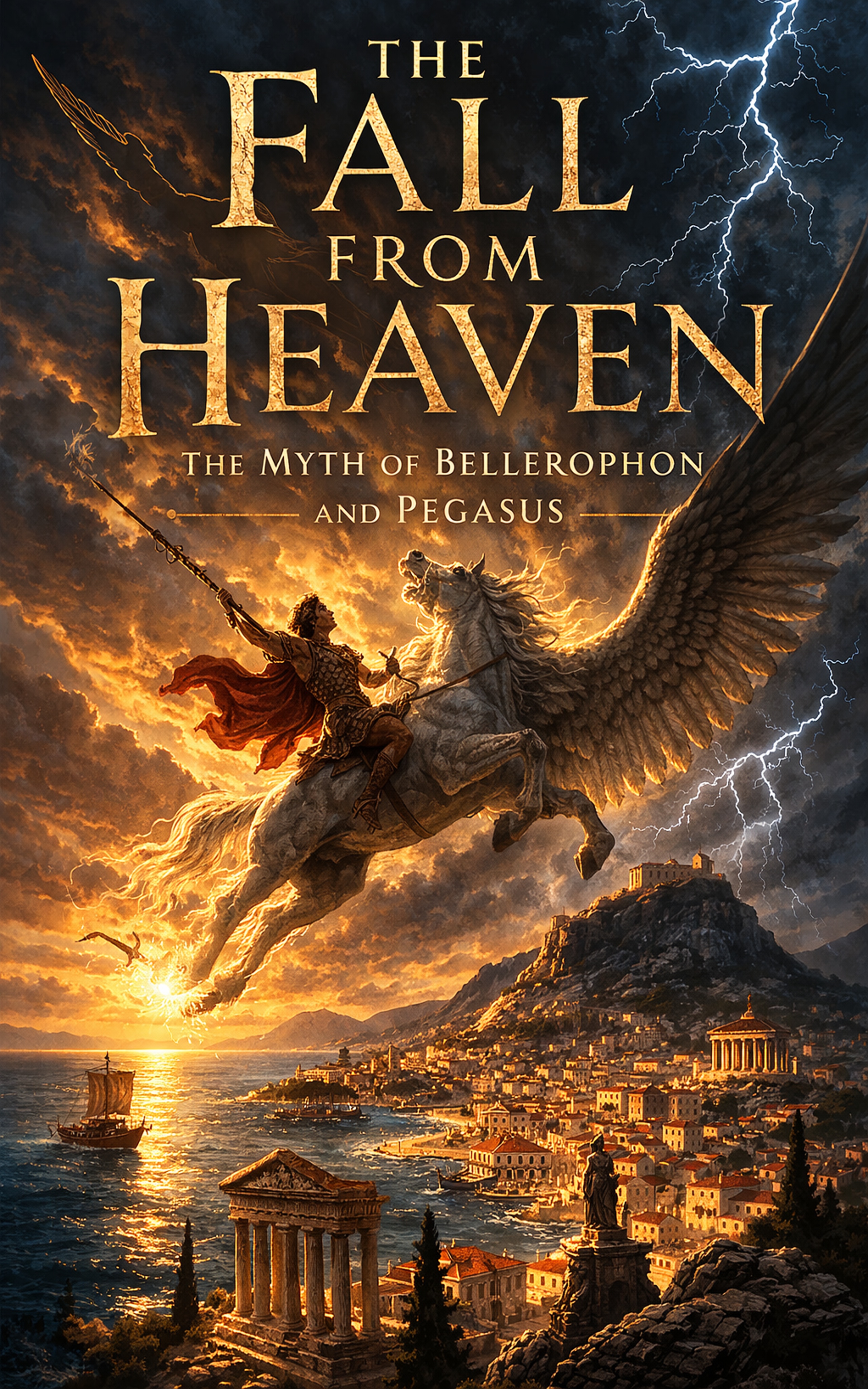 Hubris, the gods, and the long fall that follows. That’s my novel The Fall from Heaven. Read it on Amazon →
Why Did Bellerophon Fall From Pegasus?
There's a philosophical point buried here about divine favor. The gods in Greek mythology are generous with help right up until that help produces someone who no longer needs them — and that's exactly when the help stops and the trouble starts. Bellerophon had been given Pegasus, guided by Athena, and had survived everything the mortal world could throw at him. His reward was a kingdom, a wife, and a life that, by any reasonable measure, counted as success. The myth does not explain precisely what made him decide that was insufficient. It simply tells us that he tried to fly to Olympus.
Call the attempt ambition, or call it ingratitude. It depends on your sympathy for a man who has already been treated extraordinarily well by the gods and still wants more. Zeus, whose perspective on these matters was both omniscient and not particularly forgiving, sent a gadfly. The gadfly stung Pegasus. Pegasus bucked. Bellerophon fell.
How Did Bellerophon Die?
He didn't — not in any way the myth bothers to record. That's the detail the simplified version always drops. Bellerophon falls from Pegasus, survives the fall, and then — in the way ancient sources handle endings they find awkward — simply keeps going.
He wandered. The gods don't finish him off. They withdraw, which amounts to the same thing without the drama. He spent the rest of his life on the Aleian plain — a name that means, roughly, the plain of wandering, which is the ancient world's tidy way of saying this is where people who had lost their story went. Lame, alone, hated by the gods, eating his heart out — the standard Greek formula for grief with no bottom.
What he'd actually lost on the Aleian plain wasn't his life. It was his narrative: the man who killed the Chimera was gone, and what remained was whatever the gods left behind when they took back everything they'd lent him. Pegasus, meanwhile, became a divine horse. It turns out horses are never punished for flying too high — only the men riding them are. The gods kept the horse. They gave the man a limp.
The Fall from Heaven is, at its core, a story about one line: the one between worthy ambition and fatal presumption. You can't see where it is until after you've already crossed it. The gods in this myth are not wrong, exactly — Olympus really isn't available to mortals, and the rule is enforced without exception. But there's something uncomfortable about a world where divine gifts lead inevitably to divine punishment, where the capacity to dream upward gets built into you at the same moment as the ceiling that will stop you. Bellerophon is not a fool. He is not even, in the strictest sense, wrong to try. He is simply human, which in the Greek scheme of things was always the proximate cause of tragedy.
The Fall from Heaven: The Myth of Bellerophon and Pegasus
Book One of the Myths of the Ancient World series. The retelling of Bellerophon's complete story — from Corinth to the Chimera to the attempt on Olympus — in a voice that has no particular interest in celebrating the legend at the expense of the person inside it.
Also on the blog: