Why Did Orpheus Look Back?
The myth does not say. Virgil calls it sudden madness — subitam dementia cepit. Ovid does not even bother with a reason. Orpheus looked back, and the whole story collapses in a single movement, and neither poet tells us what was in his head when he did it. That gap has kept the story alive. Poets, philosophers, painters, and composers have been filling it for two and a half thousand years (which is either a tribute to the myth or a two-thousand-year failure to leave well enough alone, depending on your mood). The ancient sources tell us what happened. They stay silent on why. And that silence, I think, is the point.
The myth in its full form is surprisingly late to reach us. Plato mentions Orpheus in the Symposium and the Republic, but with real coolness — Plato thinks little of a man who, unlike Alcestis, didn't die for love but talked his way into the underworld alive instead. Plato does not have much patience for men who charm their way into things rather than dying for them. (It is a consistent position across his work, and you can see the appeal of it, even if it leaves the whole poetic tradition a little embarrassed.) The full story — the descent, the lyre's persuasion of Hades, the condition, the backward glance, the second death — comes to us mainly from two later poets. Virgil wrote his version in the fourth Georgic, in the first century BC. Ovid wrote his in the tenth book of the Metamorphoses, a few decades later. Both are brilliant. They tell it very differently.
Virgil and Ovid: The Same Story, Two Versions
Virgil's version carries the most emotional weight. He tucks the Orpheus story into a long didactic poem about beekeeping — the fourth Georgic — which sounds like an odd home for it. I've come around to thinking it's exactly right. Bees are Virgil's picture of collective, anonymous, self-sacrificing labor. Orpheus is the opposite: the one man who refuses the collective arrangement and insists that his own grief matters more than the system around him. When he looks back, Virgil gives the cause in a single Latin phrase: subitam dementia cepit — "sudden madness seized him." Madness. Not doubt, not love, not impatience. Madness. The controlled musician, the man who had charmed stones and rivers with his lyre, loses his grip on himself for one second — and that's Virgil being very Roman about it: emotion as pathology, grief as a force that overrides the rational mind.
Ovid, typically, sees it differently. In the Metamorphoses the backward glance barely gets a sentence — Orpheus looks back, it happens, and Ovid moves on to the long mourning and the eventual death at the hands of the Maenads. What interests Ovid is not the glance itself but what comes after: the grief that won't resolve, the consolation Orpheus refuses, the way loss becomes a permanent way of living rather than a wound that heals. After Eurydice dies the second time, his Orpheus goes on to compose the songs that fill the rest of Book Ten — stories of love, including Pygmalion and Adonis. That's Ovid's way of saying art is what grief does with itself when it has nowhere left to go. Tidy, for an unsolvable problem. Ovid was good at those.
What the Glance Actually Costs
The reading I keep returning to is the one that takes seriously the possibility that Orpheus looked back on purpose. Not consciously, not with a plan — but with some part of himself that understood what looking back would mean and chose it anyway. Eurydice behind him in the underworld was real and following. Eurydice in the light of day would be alive, changed, returned from death, requiring him to become someone other than the man who had just descended to the underworld for her. The man who descended — the man who charmed Hades with his lyre, who made Persephone weep, who stood in that company and played — that man could only exist in the shadow. In the light, he would have to become a husband again, with all the ordinary weight that entails. The myth never gives us a happy Orpheus in a completed marriage. Every version of him we have is defined by grief or the descending that grief requires. The happy version of Orpheus does not have a story. He just has a wife and a lyre, and the myth has no particular use for those.
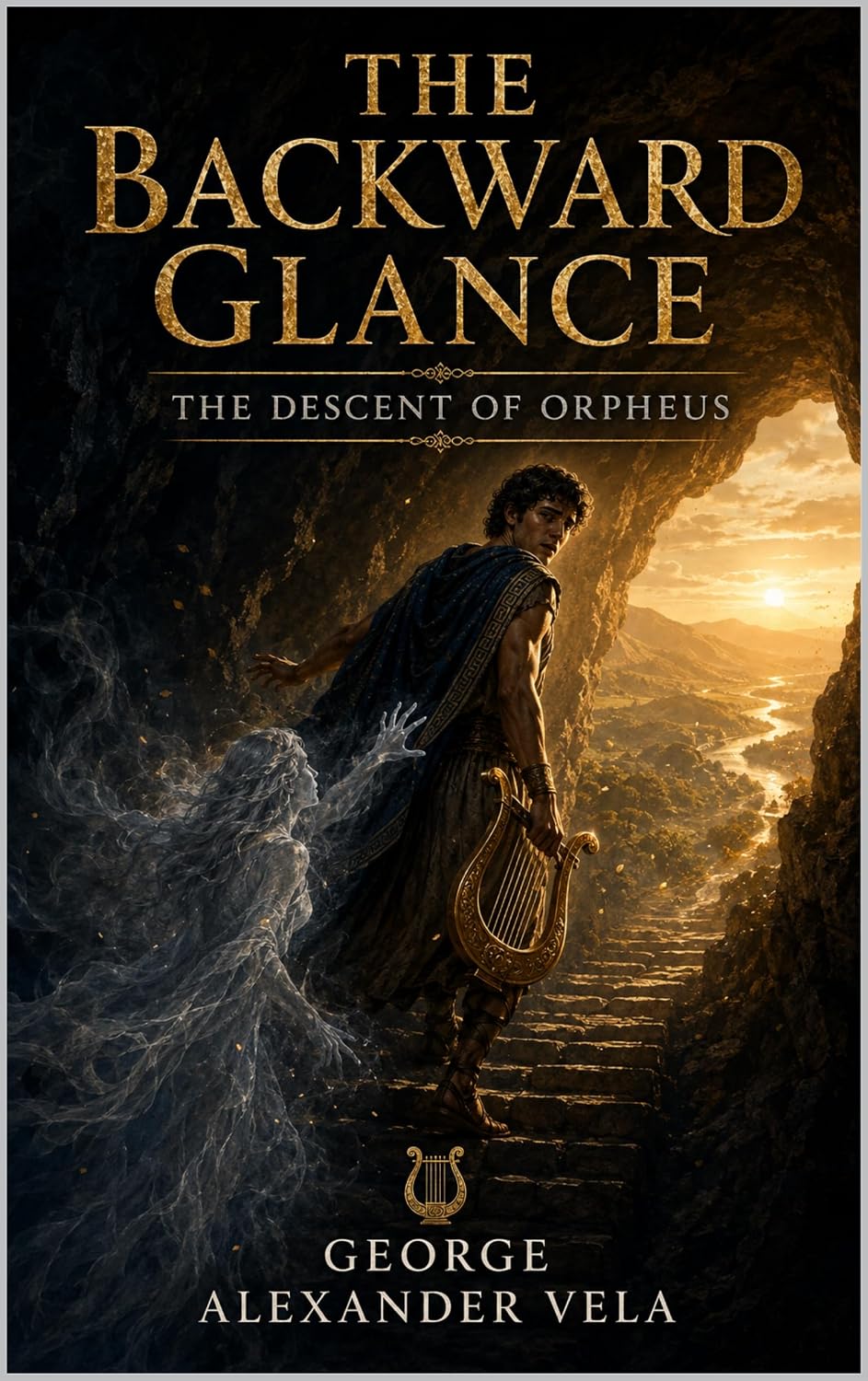 The most famous walk in Greek myth, told step by step, doubt by doubt. That’s my novel The Backward Glance. Read it on Amazon →
There's a version of the story that makes this whole argument beside the point, and I held it back on purpose. Go back to Plato. In the Symposium, Plato doesn't just call Orpheus a coward for talking his way into the underworld instead of dying like Alcestis — he says the gods never gave him the real Eurydice at all. What came up out of the underworld was a phantom, an eidolon, sent up as the punishment. If Plato is right, the backward glance cost Orpheus nothing, because he never had her back to lose. He'd been carrying an illusion the whole way up the tunnel and didn't know it. That's either the cruelest reading of this myth or the kindest one (I go back and forth), because it turns the tragedy into something closer to a joke the gods played on a man too clever for his own good.
The Orphic tradition, the mystery religion that sprang up around Orpheus's name, treated him as a founding figure — a prophet who descended to the underworld and came back with knowledge that ordinary mortals could not access. The Orphic gold tablets, found in graves across the ancient Mediterranean from the fourth century BC onward, contain instructions for the dead: what to say at the crossroads, which spring to drink from, how to identify yourself to the guardians of the underworld. This is the Orpheus who matters to the religious tradition — not the failed lover but the successful traveler, the man who went below and returned. But in the mythological tradition, what he brought back was not wisdom. He brought back nothing. He looked back. The empty road behind him is the whole story.
Orpheus turns up again as one of the Argonauts, in Apollonius of Rhodes's Argonautica, where his lyre drowns out the Sirens and saves the crew. I find him the most interesting man on that ship, and it's because he's the one who has already lost everything. He carries the one thing that can't be recovered. The other Argonauts have objectives. Orpheus has a reason. Music isn't decoration for him — it's necessity, the shape grief takes when it has no other outlet and has to go somewhere. Read this way, the myth isn't about failure at all. It's about the cost of being the person the music comes through.
The Backward Glance: The Descent of Orpheus
The most famous walk in Greek myth, told step by step, doubt by doubt. Told in full in this novel.
Also on the blog: