Who Made Medusa a Monster?
Medusa was a Gorgon whose gaze turned people to stone. Most people know her from Perseus's story — the hero who killed her. But the earlier tradition says something different: she was once human, beautiful, and transformed by Athena as punishment. Punishment for what? For a violation committed against her, not by her — the goddess punished the victim. That reading is Ovid's, though, and it arrives late. The version most people know is simpler. Medusa is a Gorgon, born that way in Hesiod — no explanation offered or required. Perseus kills her. Her severed neck releases Pegasus. Her head ends up on Athena's aegis, where it goes on doing what it always did. Clean, efficient, and entirely without remorse for the person at the center of it. What Ovid does in fourteen lines of the Metamorphoses, almost as an aside, is considerably more uncomfortable. He makes Athena the author of the monster.
Ovid tells this version in the Metamorphoses, book four, almost as an aside. Perseus is explaining to Andromeda's family how he came to have the Gorgon's head, and in the middle of the explanation, he mentions that Medusa was once beautiful — famously beautiful, the most beautiful of the three Gorgon sisters. Poseidon raped her in Athena's temple. Athena, furious at the desecration of her sacred ground, punished Medusa by turning her hair to snakes. Ovid gives this in fourteen lines and then moves straight back to Perseus's adventures, as though nothing of particular consequence has just occurred. He has been writing the Metamorphoses for three and a half books by this point. He has already established, with considerable thoroughness, his governing principle: divine beings do what divine beings want, to whoever happens to be nearby. The transformation that follows is where mythology stops asking you to feel anything about it. Fourteen lines was enough. He trusted his reader to finish the arithmetic.
What Athena Punished and Why
Ovid's fourteen lines force a conclusion: Athena punished the victim. The goddess of wisdom, patron of just war, defender of Athens, turned a woman who had been violated in her own sacred ground into a creature — one whose very existence would justify her own killing. This is not the version the early Greek sources prefer. In Hesiod's Theogony, the Gorgons are simply monsters — daughters of the sea-deities Phorcys and Ceto, born that way, with no origin story attached. In Pindar and Simonides, Perseus's quest is a straightforward heroic adventure with a straightforward monster at the end of it. The transformation narrative is largely Ovid's contribution. That means it arrives late — from a Roman poet working three or four centuries after the canonical Greek sources. And it arrives reading, two thousand years on, like the kind of provocation a clever poet plants while keeping a perfectly straight face.
Ovid was not, to put it mildly, a naive writer. His Metamorphoses is structured around transformation. But the transformations almost never happen to people who did anything to deserve them, in any simple moral sense. They happen to people who were in the wrong place, who attracted the wrong attention, or who had the misfortune of being beautiful near a deity who wanted them and saw no reason not to act on it. (The gods of the Metamorphoses are, as a group, the most powerful and least self-restrained characters in all of Latin literature — which is an achievement.) Medusa fits this pattern exactly. She was punished for being violated. The punishment was to be made monstrous. The monstrousness was then used to justify her killing.
There is a structural logic here that the myth never quite acknowledges. If Medusa's gaze killed, she could not be approached. She was isolated as completely as if she'd been walled off — except the walls were her own body, and the goddess had arranged them to function as a kind of perimeter security. She was therefore the only creature in the ancient world who could be reached only with a mirrored shield, winged sandals, and the personal help of the very deity who'd built the perimeter in the first place. It's an arrangement that resembles nothing so much as a landlord who creates a pest problem in a tenant's flat and then keeps the only key to the exterminator's van. Perseus required winged sandals from Hermes, an adamantine sword, and a kibisis bag to carry the severed head without looking at it. The hero who killed her needed the active cooperation of the goddess who'd made her unkillable by ordinary means. Ovid does not comment on this directly. He does not need to.
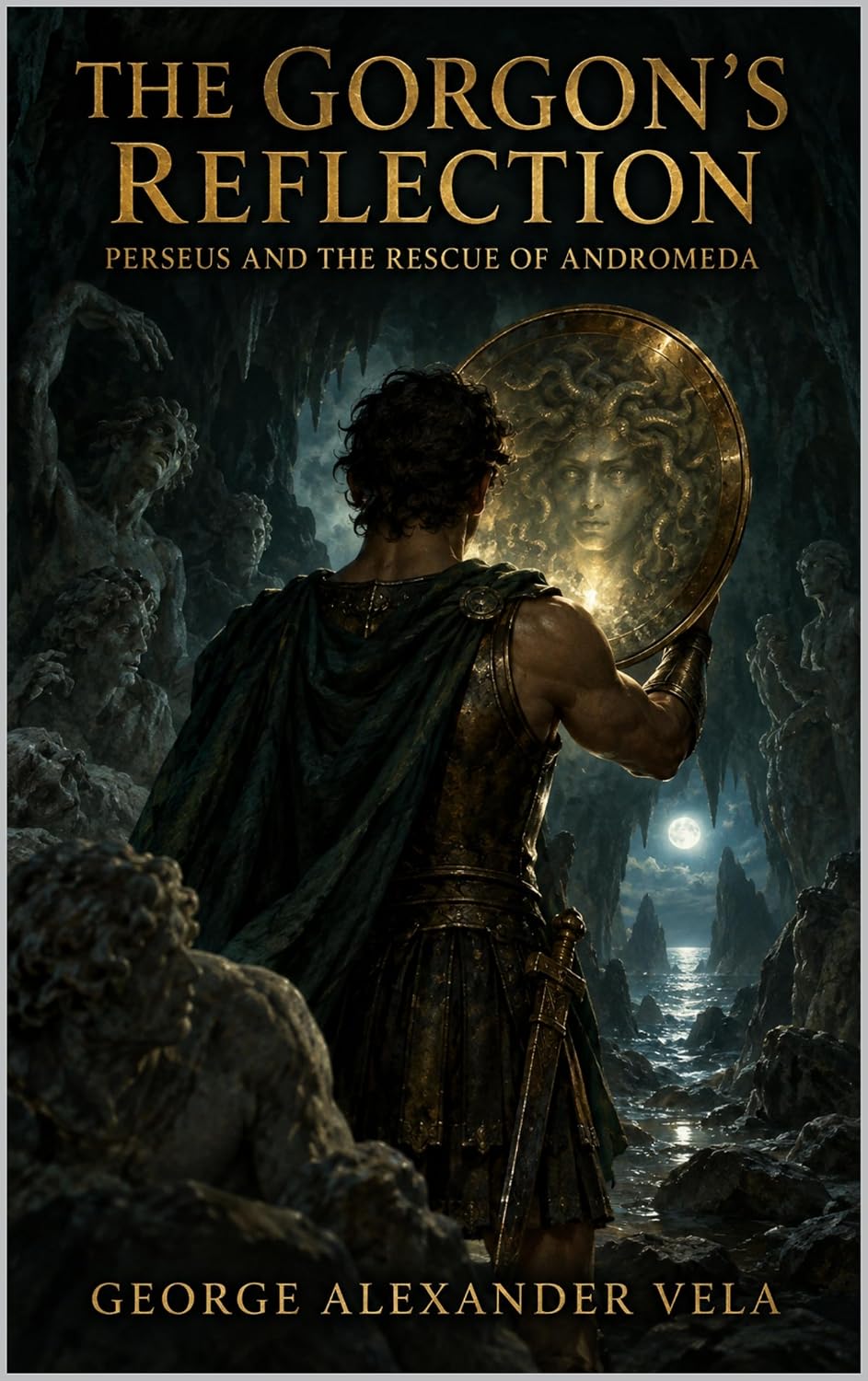 The mirror-shield, the winged sandals, and the whole quest to reach her — that’s my novel The Gorgon's Reflection. Get it on Amazon →
The Life That Came After Her Death
What happens to Medusa after Perseus cuts off her head is one of the stranger details in the tradition. From her severed neck spring Pegasus, the winged horse, and Chrysaor, a giant carrying a golden sword. Both are born full-grown from a dead body — the horse already winged — emerging from the stump of a neck while their father's war prize bled out on the ground. Their father, in the versions that give parentage, is Poseidon. That means everything Poseidon did to Medusa was gestating inside her during the years she spent exiled at the edge of the world — and it is the act of her killing that releases it. Perseus carries the severed head south across the sea in a bag. The blood that drips from it as he flies becomes the first coral — a detail Ovid includes without comment, and one worth stopping on. Coral is beautiful, skeletal, and the permanent residue of something that was once alive and never chose to stop being so. Nothing is wasted. The myth is almost offensively efficient.
Writing The Fall from Heaven required me to think carefully about what kind of animal Pegasus actually was — which meant thinking carefully about this. He is the architectural center of that book, the image everything else is organized around. I found I could not write him without the knowledge of what he emerged from — even in scenes where Pegasus is simply moving through the air, carrying someone, doing what a horse with wings does. You cannot write that horse honestly while holding the easier version of events in your head: the triumphant birth, the winged creature rising into the sky, the hero's reward. Pegasus is not born in triumph. He is born from a severed neck on the floor of the world's edge. The two images — that birth, and the animal in full flight above the Aegean — belong to the same creature. Together they make a different kind of story than the one where the monster is just a monster, and the hero's victory just a victory.
The Hesiodic tradition — where the Gorgons are simply born monstrous and no one has to explain anything — is in some ways the more honest version. Monsters exist. Heroes kill them. The world is marginally safer. Everyone goes home. What Ovid does by inserting the transformation narrative is something considerably more awkward: he makes the myth about the creation of the monster rather than the monster itself, and he places the creation in the hands of a goddess who had, objectively, other options. Whether this is critique, storytelling complexity, or just Ovid being Ovid (which is a category that explains a great deal) is anyone's guess. Classical scholars have been arguing about it for roughly five hundred years, and I do not expect the argument to resolve soon. Ovid is not available for comment. What I am certain of is that once you have read his fourteen lines, you cannot read the Perseus story without them. The monster who needed killing and the woman who needed a different god are the same person. The myth knows this. It just can't look you in the eye about it.
The Gorgon's Reflection: Perseus and the Rescue of Andromeda
Perseus from the wooden chest to the stars — the impossible errand, the mirror-shield, and the woman this myth never gave a fair hearing until now. Out now on Kindle, $0.99, free in Kindle Unlimited.
Also on the blog: